dance, theater and music by Mary Ellen Hunt.

Saturday, March 8, 2008

Alvin Ailey chief Judith Jamison on retiring

She is the public face of one of the most popular and successful dance companies in the world - an articulate and warmly generous spirit who has led the Alvin Ailey American Dance Theater for just over 18 years, handpicked by Ailey as his successor.

Under her direction, not only has the Ailey company grown from a small troupe of dancers struggling to fulfill the vision of its founder to an internationally renowned 30-member company, but it has also built its own $56 million building in the heart of New York - which also houses a second company as well as Ailey's highly regarded school - and achieved financial security with a $22 million endowment.

But with Judith Jamison's announcement last month that she plans to retire as artistic director by 2011, the question for the company is who can possibly succeed her? Jamison, 64, answers that question and others as she takes a break during her company's residency in Berkeley this week.

Read more on the SF Chronicle site.

Labels: , , , , ,

Sunday, October 7, 2007

Wherefore art thou Joffrey Ballet?

I used to wonder what exactly critics meant when they'd say that a piece of work was "wretched." I imagined scruffy dancers clad in rags, shuffling along to dirges. I have since come to what admittedly might be a completely different-- and perhaps only particular to me-- definition of the term. It is a work that makes you feel wretched. Hide your face in your hands, I want to weep wretched.

I might as well say now that this was my feeling on seeing the Joffrey Ballet during their recent run at Zellerbach Hall in Berkeley. And I think I also ought to mitigate what probably sounds like critical hyperbole, by saying that this was a personal reaction, based on what I had hoped to see, and what I then didn't get to see. Other people in the audience obviously had a far more positive experience that evening, if the applause and shouts at the final curtain call were anything to go by.

But I couldn't join in. Like someone looking for a piece of lost childhood only to find it's been paved over and made into a strip mall, I felt, honestly, a little heartsick.

As a born New Yorker, I'm one of those hordes of people who are terribly sentimental about the Joffrey Ballet. One of my running jokes is that whenever a dancer is mentioned in our house, I always add, "Oh, and of course she was with Joffrey."

There's a reason for that -- at one time everyone was with the Joffrey, because Joffrey wasn't just at the epicenter of American ballet, it was American ballet. Fresh, quirky, technical, but with soul, Joffrey had an idiosyncratic reputation, but kept everyone coming back because we all wanted to know what they'd do next. The rep included Ballets Russes revivals and works by fresh faces in American choreography. They did high energy populist works like Gerald Arpino's Trinity, and high drama in John Cranko's Romeo & Juliet. They did biting satire in Kurt Jooss' Green Table and broad comedy in Ashton's La fille mal gardee. It was a company that gloriously defied categorization.

So when I realized what ballets the company was planning to perform here in Berkeley, I had to wonder why on earth, with the vasty Joffrey repertoire available to them, would the company choose to bring Billboards, of all things, on this tour--its first in to the Bay Area in many years.

I have nothing against Laura Dean, and certainly Prince's music is not to be sneezed at. But from the larger than life vinyl banner that proclaims "BILLBOARDS" across the body of a sexily lounging female dancer (with a small, but legible "Gannett" logo at the hem) there was an atmosphere of slick and yet desperately dated commercialism that summed up their Zellerbach appearance.

As far back as 1996, critic Clive Barnes warned of the danger of relying on commercially viable, but artistically void Billboards as a staple of the Joffrey repertoire. In an editorial for Dance Magazine, he said presciently,
The Joffrey over the years has built up a fabulous repertoire of modern classics--from, most notably Ashton, Massine, and Jooss -- and a fascinating Ballets Russes collection, as well as many decent creations, particularly from Arpino himself. It was a company with a plan and a purpose, a national company, distinct from both New York City Ballet and American Ballet Theatre, and a company that overseas could represent American classic ballet at its best. If to survive it has to give up the very thing that made its survival important, one wonders what has been gained.
(Dance Magazine, November, 1996)

So what's it doing on the rep of Joffrey's tour, a tour celebrating the company's 50th anniversary? And why has the company brought two of the most tired items from their 70s and 80s years? Even if these pieces might have been fresh back then, has the Joffrey acquired no newer, more interesting, more relevant repertoire since then? I catch myself thinking this is decidedly not the Joffrey that I grew up idolizing.

It's not to say that the company lacks talent in the dancers. To the contrary, the company has a number of engaging dancers in Stacy Joy Keller, Heather Aagard, Willy Shives, but there's only so much they can do in a situation where the company direction is obviously lacking.

I must admit though, that I was somewhat horrified to see that Pas de Deesses, once a staple of the Joffrey repertoire, looked so close to parody. What has happened to coaching? I had to go back to a former Joffrey ballet master to ask what the atmosphere of the ballet was supposed to be. Was I remembering it through a child's rose-colored glasses? Where was the warmth, the airy Romantic graces with the hint of gracious rivalry?

Devised by Robert Joffrey as a tribute to the beautiful Romantic era in the vein of Pas de Quatre, the dancers are meant to look as if they'd just stepped from a lithograph.

The dancers-- Kathleen Thielhelm as Taglioni, Victoria Jaiani as Grahn, Keller as Cerrito and Fabrice Calmels as Arthur St. Leon -- are lovely to look at, but seemed to have little idea as to what was interesting about the interaction between these 19th century personalities or differentiating from, even contrasting with, the style of contemporary ballet. In fact, this performance was decidedly 21st century--developpes carried the legs up to the nose and around the body 180 degrees to back of the head, eliciting gasps from the audience members behind us. All I could think was how horrified Grahn would have been at the idea of showing off her nether-regions to the audience in such an unladylike, contortionist fashion.

Unfortunately, the Tharp Deuce Coupe which followed on the program, has also not kept pace over the years, though I would argue that the fault lies in the choreography and not the coaching. Set to a Sessions Presents the Best of amalgam of Beach Boys hits, it looks even more dated than Pas de Deesses. None of its nineteen sections stays long enough to really grate on you, but the whole exercise has forced jollity, and a self-conscious coyness to it.

Against a graffiti tagged trio of walls, the men --in red spandex and Hawaiian shirts, think Freddie Mercury raiding Don Ho's closet -- slink and sidle across the stage in hip-swivelling glissades across the stage. The women-- dressed no better in Scott Barrie's unflattering short orangey-tan dresses-- bop interspersed among them, ponytails swinging.

Tharp provides no narrative stream, unless you count the subplot of Heather Aagard as the ballerina performing uncomfortable ballet class combinations in pointe shoes in the middle of the stage. The work is admittedly early Tharp, but like many choreographers, she appears here to have no idea what to do with a woman in pointe shoes except to make her stand on tippy toe or spin fast. When not performing these feats of balance, which Aagard manages admirably, she has to sidle and swivel uncomfortably next to people having a lot more fun in jazz shoes. This is an antiseptic version of Hair-- which dates from about the same period-- all pelvis, but no sex.

For a moment, I almost thought that this was her intended story -- a young virginal, sexless ballerina taking class at the Joffrey studios on 6th Ave, surrounded by the hot and heavy urban grit of New York's Village scene. But it hardly seemed worth the effort to try to figure out what was going on -- an episode would fade away before you could even register the players. There aren't many choreographers as frustrating as Tharp. You can't dismiss her, because every so often, she puts together an interesting step, but she's made much better and more worthwhile pieces since Deuce Coupe.

And thus did we arrive at the concluding work, Billboards.

If I've asked a lot of questions here, it's because I asked so many during the performance.

What has happened to the Joffrey I remembered -- a company that addressed themes and issues relevant to contemporary audiences while presenting a context of classical roots? What's with all the boppy, poppy stuff when I know there are better works at the company's command? Does the Joffrey think so little of their audiences in other cities that it chooses to present such a poorly-thought out program of minor work, or does it truly believe that this is the way to entice new dance-lovers? Is this what companies do nowadays to survive in a financially strapped arts funding landscape? Is this what American ballet has come to?


Labels: , , ,

Wednesday, September 26, 2007

Mark Morris' "Mozart Dances" at Cal Performances

Sept 21, 2007
Zellerbach Hall, UC Berkeley

I worry when a choreographer makes a full-evening length dance that works--one that's not a story-ballet or a polemic, that can keep an audience focussed and not fidgeting in their seats as you begin section 11 of a 12-part work.

Aw, hell, I think to myself, now every yahoo is going to think that they're as skilled as Mark Morris -- that they can pull off a whole night's worth of abstract modern dance just like "Mozart Dances," which had its West Coast premiere at Zellerbach Hall at UC Berkeley recently. He makes little things like organic form and reformed structure look too easy.

Facetiousness aside, however, Morris impressively leads the audience on an engaging excursion through a beautiful three-act work set to Mozart's Piano Concerto No. 11 in F Major, his Sonata in D major for Two Pianos, and his Piano Concerto No 27 in B-flat Major.

To call it ambitious would be patronizing. Morris is too canny a dancemaker to attempt a large scale work without thinking through the nuts and bolts and "ambitious" implies a certain amount of failure in the very word. "Mozart Dances" is not my favorite of his works-- I reserve that title for his exhilarating "L'Allegro"-- but it is both satisfying and successful on a grand scale.

The tone here is simple rituals, with shades of 18th century airs and graces, reflected in Martin Pakledinaz's black and blue-gray knee breeches for the men and diaphanous dresses for the women. Broken into a section mainly for women ("Eleven"), one mainly for men ("Double") and one for a happy intermingling of both genders ("Twenty-seven"), Mozart Dances seems to allude to everything and nothing. A wry comedy of manners? Sistahs doing it for themselves? Menacing, dangerous liaisons?

Morris famously admires the work of George Balanchine, and there's several "Serenade"-like moments of scattered throughout the evening -- the dramatic, plunging swoon to the floor, the gauzy moonlight skirts of the women during their brief interlude in "Double," the second act of the evening.

And yet it wasn't Balanchine that "Mozart Dances" evoked for me, but rather the earlier grittier "Les Noces," by Bronislava Nijinska, circa 1923. It wasn't the score -- Mozart is rather different from the pounding, earthiness of Stravinsky's peasant wedding -- but rather the look of things.

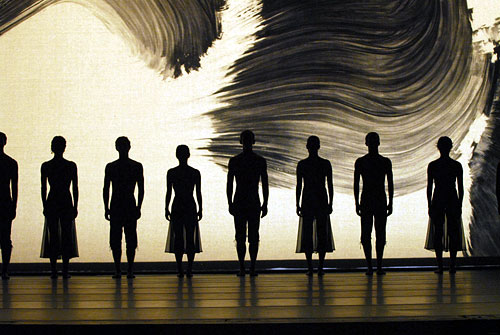
The stark force of Howard Hodgkin's curtailed, painterly brush-strokes-- writ-gargantuan on the cyc in the back-- the architectural groupings and waving of the women in "Eleven" recalled the severe austerity of Nijinska to my eye. Almost certainly, Morris had no intention of evoking a Nijinska's broadly-drawn modernist ballet, but all the same, my mind, grasping for narrative threads, settled on this one.

That there is a ritual feeling throughout "Mozart Dances" is no surprise, given Morris' mastery of the folk dance forms. The weaving patterns of the women as they wound in and out of Lauren Grant's dance in "Eleven" called up the braiding of the bride's hair in "Les Noces'" first tableau. Two poignant solos for other women brought to mind the lamenting mothers of the third tableau. And then the mixture of dreamy sentiment and manly urgency in "Double" made me think of the Consecration of the Groom scene. By the time the curtain rose on Hodgkin's final image -- this time featuring an angry red swath across the space, like virginal blood displayed on the wedding sheets -- I was sure I had the story nailed.

Am I way off-base with my Russian Peasant Wedding theory? Almost assuredly. Reviewing the "Mozart Dances" in the New Yorker, Joan Acocella reports that Morris himself cites the madcap ending of Mozart's opera buffa "Cosi fan tutte." Fair enough. Mozart's pretty far from Russia.

It doesn't stop me from secretly clinging to my theory. After all, that's the flexible pleasure of abstraction. Choose your story and run with it.

For more information, check out cal Performances'
extensive webpage on the event with links to video clips and program notes.

Labels: , , , ,

Tuesday, September 4, 2007

Bausch's 'Ten Chi' will haunt your dreams

There are those kinds of artists that impress, those whose work sticks in your brain and those who can change the way you think -- and then there are those that haunt your dreams. It is into the last category that Pina Bausch's Tanztheater Wuppertal falls.

I first saw her startling "Carnations" as a teenager, and I have never forgotten its bizarre, frightening and yet somehow moving imagery -- or how closely hilarity and sadness seemed to cavort together on a carpet of thousands of pink carnations. Was it absurd that she asked the audience to pretend-hug ourselves? But in the end, almost as if by magic, Bausch uncovered a deeper meaning to all of these gestures that left me feeling slightly forlorn. Perhaps underneath it all, I felt, even then, that Bausch was a romantic, and it seems over the years that her work has grown only more poetic.

With "Ten Chi," which Cal Performances presents this November at Zellerbach Hall, Bausch transports us to Japan, where she created and premiered this work in 2004 at the Saitama Arts Theater. Translated roughly as "heaven and earth," "Ten Chi" draws its inspiration from Bausch's and her dancers' experience of the Japanese culture as outsiders, the martial arts, the language, the everyday interactions.

It's a mix reflected in the wide range of musical sources, Asian and European, such as Ryoko Moriyama, Hwang Byungki, Kodo, Yas-Kaz, Gustavo Santaolalla and Rene Aubry, as well as experimentalists such as Portishead's Beth Gibbons, Plastikman (Richie Hawti) and Tudosok -- all played out in an exotically simple setting, shadowed by the tail of a giant whale sounding into the stage.

But if "Ten Chi" sounds potentially obscure, even frustrating, fear not. In the realm of postmodern dance, Bausch is the master of dance theater -- and artists from Bill T. Jones to Robert Wilson to William Forsythe owe her a debt. Dominated by powerful and extraordinary images, her works are at once grandiose and intimate, ridiculous and yet familiar, but always they have the power to reveal something you never realized about yourself. She might even ask the audience to do things that seem silly or uncomfortable, but by whatever means are at her disposal, Bausch intends to make us feel the desire to communicate, to reach out and touch someone.

I expect that my dreams will be haunted again, perhaps by leviathans in the ocean and scattered cherry blossom petals floating on the water, or maybe by the simplest of human gestures. You just never know what we might discover.

Highly Recommended

  • 'Mozart Dances' -- The Mark Morris Dance Group returns to Cal Performances with this evening-length work, whose rhapsodic flair has engendered comparison to Morris' grandest works, such as "L'Allegro il Moderato ed Il Penseroso." Details: Sept. 20-23, Cal Performances, Zellerbach Hall, UC Berkeley, $32-$72, 510-642-9988, http://www.calperfs.berkeley.edu.

  • Joffrey Ballet -- The quintessential American maverick ballet company performs homegrown works, including Twyla Tharp's "Deuce Coupe"; Laura Dean's segment from "Billboards"; and "Pas des Deeses," created by the great Robert Joffrey himself. Details: Oct. 4-6, Cal Performances, Zellerbach Hall, UC Berkeley, $34-$90, 510-642-9988, http://www.calperfs.berkeley.edu.

  • Armitage Gone! Dance -- Once known for confrontational punk-ballet, Karole Armitage introduces her new company to the Bay Area with the grand lyricism of "Ligeti Essays" and "Times is the echo of an axe within a wood." Details: Oct. 13-14, San Francisco Performances, Yerba Buena Center for the Arts, $27-$39, 415-978-ARTS, http://www.performances.org.

  • Oakland Ballet -- The beloved Oakland Ballet gets a new lease on life with a program of old favorites, including Nijinsky's "Afternoon of a Faun"; Marc Wilde's "Bolero"; and Ronn Guidi's "Trois Gymnopedies" and "Carnaval d'Aix." Details: Oct. 20, Paramount Theatre, 2025 Broadway, Oakland, $15-$50, 925-685-8497, http://www.rgfpa.org.

  • Lines Contemporary Ballet -- Celebrating its 25th anniversary, Alonzo King's troupe is joined by Zakir Hussain and the Philharmonia Chamber Players in a special program featuring two world premiere works. Details: Nov. 2-11, Yerba Buena Center for the Arts, Third and Mission streets, S.F. $25-$65, 415-978-ARTS, http://www.linesballet.org.

    'TEN CHI'

  • WHEN: Nov. 16-18


  • WHERE: Cal Performances, Zellerbach Hall, UC Berkeley


  • HOW MUCH: $34-$76


  • CONTACT: 510-642-9988, http://www.calperfs.berkeley.edu

  • Labels: , , ,

    Tuesday, March 6, 2007

    Alvin Ailey diva gets unexpected -- but wholly appropriate -- 25th anniversary gift

    You could say the Earth moved for Renee Robinson, the Alvin Ailey American Dance Theater diva who celebrated her 25th anniversary with the company in a special performance at UC Berkeley's Zellerbach Hall last week.

    Of course, it moved a little more than the dancers might have liked, but the New York-based company seems to take in stride little things like Thursday's 4.2 magnitude temblor, which struck during intermission.

    Read on the Chronicle site.

    Labels: , , , , ,

    Thursday, October 26, 2006

    Lyon Opera Ballet spotlights three women choreographers

    Lyon Opera Ballet
    “Die Grosse Fuge,” “Fantasie,” “Groosland”
    Cal Performances, Zellerbach Hall, UC Berkeley
    October 27-28,2006

    When the Lyon Opera Ballet -- which Cal Performances presented at UC Berkeley’s Zellerbach Hall last Friday and Saturday nights -- gets on stage, there’s one thing you can be sure of, there will be athletic inventions of mind-bending capriciousness in the offing.

    The works that this attractive troupe performs tend to be highly energetic and physically alert on the most obvious level, but what’s most appealing is the satisfying meatiness underneath. Their triple bill this time – featuring the works of Anna Teresa de Keersmaeker, Sasha Waltz and Maguy Marin – was not a program of esoteric intellectual works, but it was smart and even provocative on a number of levels.

    The Belgian De Keersmaeker’s “Die Grosse Fuge,” for instance, made a galvanizing vehicle for the company.

    On a bare stage under the hot exposed glare of a grid of lamps, seven men and one woman play out a high velocity contest in Ann Weckx’s dark business suits. Spiralling through the air with limbs flung wide or in contracted balls, they tumble and roll to the ground with an almost intoxicated zest to the music of Beethoven’s “Grosse Fuge,” as recorded by the Quatuor Debussy.

    Although there’s a story inherent in the simple fact of putting a single woman -- Caelyn Knight -- amidst the men, De Keersmaeker doesn’t make too much of the situation, rather illustrating the fugue form in the complex patterns of choreography as dancers pick up phrases of movement and then pass it to others in rolling canons. Knight devours space as hungrily as the men, rolls up her sleeves with them and takes her tumbles to the floor with the same aggressive confidence that marks all of the Lyon dancers. But doubtless De Keersmaeker’s objective is to make you notice the very fact that you’ve noticed that there is only one woman.

    Sasha Waltz’s hazy, dreamlike “Fantasie,” which followed on the program, covers different and even more ambiguous ground. Created for the Lyon Opera Ballet and premiered earlier this year “Fantasie” – danced first in silence, then to a recording of the Schubert Fantasie in F minor – effects some arresting scenes. At the start Bruno Cezario and Fernando Carrion Caballero confront each other in an unsettlingly slow encounter in which Caballero’s arm seem to pass through Cezario’s body. Yu Otagaki tightrope walks into Caballero’s orbit for a duet of garishly twisted limbs and other dancers join them, swaying in a knot in the corner.

    In Martin Hauk’s shadowy darkness, some of the imagery is compelling. Still, one can’t help feeling that the work lacks development and is over-long. For a lengthy section of the ballet, the dancers seem to take a childlike pleasure in flitting about the stage with “airplane arms” but the story seems lost until we see Otagaki melting away from Caballero. He appears stricken and all the dancers vanish leaving Cezario alone onstage, as if within a fading dream.

    And then you have to wonder Maguy Marin’s dreams look like. Her diverting 1989 ballet “Groosland” puts 20 dancers onstage, looking uncharacteristically zaftig in Montserrat Casanova’s padded “fat suits” featuring prim blue and chartreuse outfits. They mince and teeter through complicated little folk dances with a nimble charm that elicited not a few chuckles from the audience and the Rubenesque dancers are rather touching in their obvious delight in dancing to Bach’s Brandenburg Concertos. These characters are obviously far more comfortable with their illusory flesh than you or I might be with a real body, and when the dancers strip off the blue and chartreuse to romp “naked,” we’re reminded that this or any other body is just a vehicle, and that the real grace comes from the dancer within.

    This review originally appeared in the Contra Costa Times.

    Labels: , , , , ,

    Saturday, October 14, 2006

    Dance Review: Gamelan Sekar Jaya's "Kali Yuga"

    Gamelan Sekar Jaya
    “Kali Yuga: The Age of Chaos”
    Cal Performances, Zellerbach Hall, UC Berkeley
    October 14, 2006


    A fantastical battle between gods crosses paths with the realism of a modern world out of balance in Gamelan Sekar Jaya’s spell-binding drama “Kali Yuga: The Age of Chaos,” which premiered in its entirety at Berkeley’s Zellerbach Hall on Saturday night.

    Co-sponsored by Cal Performances and World Arts West, this lavish, multi-textured work draws its inspiration from Hindu cosmology in which the last of the four cyclical yugas, or ages of humanity, is called the Kali Yuga, a dark time marked spiritual dissolution, conflict and hypocrisy. Gamelan Sekar Jaya performed excerpts of the evening-length piece at last year’s San Francisco Ethnic Dance Festival, and it is a such worthy theatrical spectacle that it seems a real pity that there was only one day of performances it.

    A collaboration that brings Hindu together with Muslim, American with Balinese, “Kali Yuga” could be taken as a microcosm of a land of diverse contradictions – a paradisical island steeped in Hindu mythologywhere families still give offerings to the gods to protect their rice paddies, and a part of a Muslim nation torn by religious conflict and terrorist violence. Directed by Ellen Sebastian Chang -- who also directed the 2001 “Kawit Legong”— this richly appointed production finds the kind of unique flavor of fusion that we’ve come to expect from this American gamelan ensemble.

    Founded in 1979, El Cerrito’s Gamelan Sekar Jaya – whose name means “victorious flower orchestra” in Balinese – has become one of the most distinguished groups of its kind in or outside of Bali. Under the musical direction of Indonesian guest artists I Made Arnawa and I Dewa Putu Berata, Sekar Jaya impressively navigates the music composed by Arnawa, along with the troupe’s general manager Wayne Vitale.

    The term “gamelan” refers to a set of metal or bamboo instruments, and each gamelan collection is tuned as a unit, with the instruments always remaining together, no matter who the players are. Sekar Jaya is comprised of five smaller gamelan ensembles whose potent combinations of percussion instruments include small metal pots, gongs, drums, flutes, and jegogan made from giant bamboo tubes, among many others. There is a universe implied in the gamelan sounds, which can elicit the sense of consonant order or dissonant chaos with equal ease, and it all adds up to a robust and deeply satisfying layering of sound that fill the ears literally, even as Elaine Buckholtz’s visuals and Jack Carpenter’s lighting fill the eye.

    The thirty musicians of Gamelan Sekar Jaya’s ensemble make for an impressive centerpiece, enfolded by a U-shaped ramp along which unfolds the epic battle between Dewi Sri, the Balinese Rice Goddess and Bursasana, a demon who disturbs the order of the universe. Looming overhead is a rough circular hanging woven out of palms highlighted by a palette of light and shifting projections, but the bulk of the action takes place at the front of stage, where divine battles metamorphose into seemingly innocuous jaunts by tourists traveling through Bali or a masked dance turns into a modern rave. It’s a pleasing arrangement which places the musicians in the middle, and sometimes as a part, of the dance drama.

    Part mythos and part morality play, “Kali Yuga” unfolds in seven episodes. There are ritualistically paced Balinese dances from the Rice Goddess – an elaborately costumed Tjokorda Isteri Putra Padmini -- and her four acolytes. I Ketut Rina unleashes savage gravelly screeches and raucous laughter as the demon Bursasana, who tempts “Kali Yuga” choreographer I Wayan Dibia, as the Man with Four Faces, while they dance an unsettling series of topeng or masked dances. There’s a nightclubbing rave, a kind of contemporary version of the Balinese warrior’s kecak dance. And as a modern tourist, Oakland rap artist Rashidi Oman-Byrd even throws in a few hiphop moves as he raps the words of Jakarta-based poet Goenawan Mohamed.

    Ambitious in scope, “Kali Yuga” gets at a multiplicity of concepts, but underlying it, there is the sense that in a world wracked by violence, nightclub bombings, vice and corruption, there is still the hope of order and consonance rising from the chaos.

    If the ending -- a few lines spoken by children -- seems inconclusive and vague, still “Kali Yuga’s” emotional resonance hangs in the air like the reverberant sounding of the gongs.

    This review originally appeared in the Contra Costa Times.


    Labels: , , , ,

    Tuesday, June 20, 2006

    Theater Review: Bigger Than Jesus

    Rick Miller
    “Bigger Than Jesus”
    Cal Performances, Zellerbach Playhouse, UC Berkeley
    Jun 20-24, 2006
    Nobody has more issues than a lapsed Catholic. “All of the guilt, with none of the calories,” is what one of my friends used to say.

    And lapsed Catholics lurk everywhere. I myself wanted to be a nun when I was nine years old. Maybe it was the ritual, the easily memorized litanies and the clear-cut rules that appeal to those at that first level of Piaget’s stage of moral development. No doubt my lapsed Catholic father was very much relieved when I stopped serving pretend Masses with Necco Wafers and talking about taking the veil.

    Rick Miller’s one man show “Bigger than Jesus” -- which plays this weekend at Zellerbach Playhouse as part of Cal Performances’ season –reminded me of the view of religion that comes through childlike – which is not to say childish – eyes. I want to say it’s a naïve view, but not naïve in an ignorant sense, but rather in an innocent one.

    Miller, a one man tour-de-force, gathered kudos for his “MacHomer” a Simpson’s-inspired telling of Macbeth, which Berkeley Rep presented earlier in the year. In Bigger Than Jesus” though, he delves into the story of the Messiah and the underpinnings of Christianity.

    Loosely framed on a Catholic mass, Miller’s 75-minute play ranges across space and time, with Miller playing Jesus as, variously, a drawling professor-cum-Borscht Belt comedian, a proselytizing minister, and a hyperactive flight attendant. It’s a versatile performance that Miller reels off with deceptive ease, but like a child’s game of playing Mass, at the end it left me unmoved and oddly uninterested in asking any of the bigger questions like, Who is this God anyway?

    Early on, we find ourselves at the start of Mass. Those with any kind of Catholic background found ourselves murmuring “Thanks be to God,” at appropriate moments, without even thinking about it. Someone speaking with priestly intonation in a darkened room and then pausing for our response – it just seemed natural.

    The production itself, designed by Ben Chaisson and Beth Kates and directed by co-writer Daniel Brooks, is superb. A video screen in the back and a smooth white floor that doubles as a white board make a simple set, but Chaisson and Kates meld video and sound together to make the kind of seamless experience that is incredibly difficult to achieve. Live video cameras that feed real-time images merge with pre-recorded tape and live action with a skillfulness that eludes a lot of theater productions these days.

    It’s a clever production, and Miller makes a genial host – never too pushy with ideas, always inclusive.

    Often lurking under the rational skin of a lapsed Catholic is an undercurrent of rage, or at least indignation. But there’s no rancor to Miller’s performance and his journey plays more like a didactic lecture, rather than any kind of commentary. I wished he had a little more bite. His notes on the portrayal of the historical Jesus, the development of the Christian faith and its place in the world today aren’t new, by any means, and it felt as though he were perhaps a little afraid to utilize the fullness of sarcasm that I sensed lurking behind the words.

    Still, Miller attacks the stage performance with phenomenal vigor and he can be raucously funny at times. At one point he prowls the house, planting a kiss on the mouth of a surprised man in the front row of the audience. He turns the camera on us and exhorts us to wave our arms ridiculously in the air as if we were at a revival meeting.

    “Quick, get your arms up before he comes over here!” my husband hisses at me. “You saw him, he’s crazy!”

    And a re-enactment of the Last Supper using a five-inch plastic Jesus action figure (I believe I’ve seen the package and it says that he has “poseable arms and wheels in his base for smooth gliding action”) bopping along to a send-up of “Gethsemane” from Andrew Lloyd Webber’s “Jesus Christ Superstar” is utterly hilarious.

    But Miller can also be touchingly honest and open about his own confusion. Perhaps his best moments are the revealing ones, where we find out little snippets of what he himself believes. But so much of the show is him not being Rick Miller that I began to wonder if he were afraid to directly address his own religious confusion.

    In the end, the bigger questions were still there, waiting to be asked.

    This review originally appeared on KQED.org.


    Labels: , , ,

    Tuesday, February 28, 2006

    Ailey: Everyday Superhumans

    Alvin Ailey American Dance Theater
    through March 5, 2006
    Cal Performances, Zellerbach Hall, UC Berkeley


    Program A (Mar 5): “Night Creature,” “Solo,” “Ife/My Heart” (Bay Area premiere), “Revelations”
    Program B (Mar 4 mat): “Shining Star,” “Caught,” “Reminiscin,” “Revelations”
    Program C (Mar 4 eve): “Love Stories,” “Urban Folk Dance” (Bay Area premiere), “Acceptance In Surrender” (Bay Area premiere), “The Winter in Lisbon”

    If you're seeking the perfect antidote to a cold, damp winter evening there is no need to look any further than the heat of Alvin Ailey American Dance Theater's annual Cal Performances season at UC Berkeley's Zellerbach Hall.

    With three different programs, the company has brought along a little bit of everything, from hip hop to ballet, classic to modern, but it almost doesn't matter which progam you choose to see -- with Ailey, you're pretty much guaranteed a night of rip-roaring, terrific dancing.

    One of the Ailey company’s most compelling qualities is the conviction they bring to their performances. There’s a core of integrity that each dancer shares on the stage and an argument could be made that it is this sincerity that has won them such a loyal following wherever they tour. Sure, the strength of their unparalleled athleticism is evident everywhere – the men mix flexibility with speed, the women are sharp-minded and unbelievably sleek. They could dance the hokey-pokey and it would be the most exciting and enthralling thing you ever saw in your life, but most importantly it would be deeply felt. Ailey never does anything halfway.

    The company has been accused of becoming too acrobatic in the years since founder Alvin Ailey’s passing. Certainly, it’s easy to believe that this group has more tricks, bigger split jumps, higher legs than ever before, but the current company still boasts dancers like Dwana Adiaha Smallwood, Matthew Rushing, Linda Celeste Sims and Renee Robinson, who bring elevation of a different sort. Ailey is now a company of the new century, and they are cannily planning how to make relevant the works of the past for new audiences who have grown accustomed to extreme performances.

    Has too much of the emotional core of the company been lost along the way? Without having seen them dance in the 1960s and 70s, it’s hard to say, but surely there is no company in the world that dances with more heart.

    Given that, it’s no surprise that “Solo” a work for three men by Hans van Manen to the music of J.S. Bach that was most recently performed here at the San Francisco Ballet Gala is a terrific acquisition for the company. The three men -- Clifton Brown, Glenn Allen Sims and Rushing – put a stamp of humor and quickfooted sureness on this piece that is 100% Ailey. On this trio, van Manen’s choreography looks less like Ballet with a capital “B.” But if the look is more like speedy wrestlers rather than sleek racehorses, the men locate the mixture of humor and hubris that draws a reaction from the audience instantly.

    It’s a boon for anyone who choreographs to be able to develop his or her work on these dancers, as was evidenced in the local premiere of “Ife/My Heart,” by hip hop phenom Rennie Harris. “Ife” refers to the location of the spiritual center for the Yoruba people of Nigeria and the nine dancers have clearly embraced the concept of a metaphorical as well as geographical heart to this work. The recent performances of his works by Harris’ own company, EVIDENCE, were intriguing, but not nearly as effective as this.

    In white loose-fitting clothes that range from African dashikis to slim modern dresses, the dancers enter in a procession of small groups – a more African inspired quartet led by an earthy Renee Robinson, an Afro-Caribbean pair and three dancers who seem more generically modern. There’s a hodge-podge of a recorded soundscape that ranges from Art Blakey to the recited poetry of Nikki Giovanni, which almost, but not quite detracts from the pleasure of watching Brown’s hip hop phrases –the quick switches of weight from foot to foot, the scooping sweep of the hands— that Linda Celeste Sims and Asha Thomas perform with razor sharp focus. Among the men, Rushing, Jamar Roberts and Amos J. Machanic stood out whether solo or in a group for that same intensity of focus.

    Brown typically structures his work around certain anchors – the opening processional, unison sections punctuated by ecstatic tribal dances, a communal circle, etc. His ballets often finish up in a free-wheeling house-music finale and “Ife/My Heart” is no exceptional, although in the case of Ailey’s performance the beat seeped palpably into the entire Zellerbach audience in a sort of low- throbbing pulse that was visible in bobbing heads and shoulders. It was the kind of dance that somewhere deep in your cells, you felt you already knew.

    The program also included the sinuous “Night Creature,” a slinky, caterwauling Ailey standard to the music of Duke Ellington. Smallwood leads the pack of distinctly feline night creatures with hepcat, high-stepping style. If hers are not the most perfectly balletic jetes, there is no one in this troupe to match her for deep sweeping back arches and hip swivels. She’s having such fun that you can’t help but have fun yourself just by watching her stray cat strut as she pulls faces at every dancer on stage.

    As usual, the company closed with the rousing Alvin Ailey classic “Revelations.” Every year Ailey brings it back but if you think that you’re “Revelation”-ed out, trust me, you only think you are. See it one more time, and you’ll be amazed at how easily you can be swept into a Baptist fervor. After 46-years, the dancers still pour inordinate amounts of energy into this gospel inspired crowd-pleaser, and they are rewarded at nearly every performance with hoots, hollers and standing ovations.

    Tuesday night’s cast delivered all the usual pleasures: Dion Wilson hitting an edgy tone in “Didn’t My Lord Deliver Daniel,” the husband and wife Simses adding perfectly tuned empathy and humanity to “Fix Me Jesus” and Amos J. Machanic, Jr. making classroom contractions of the abdominals look stunning in “I Wanna Be Ready.”

    It was a performance made remarkable by the very fact that this is how Ailey dances every day.

    This review originally appeared in the Contra Costa Times.


    Labels: , , , ,