dance, theater and music by Mary Ellen Hunt.

Sunday, September 27, 2009

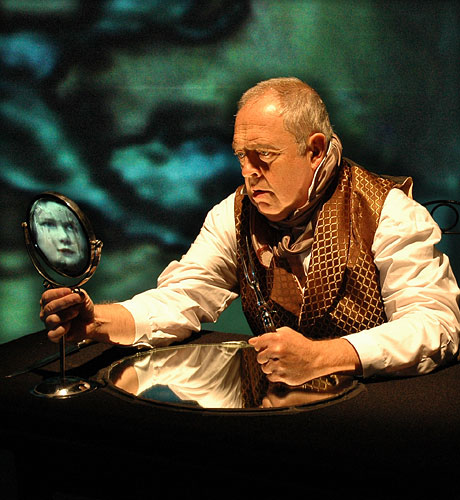
Bill T. Jones finds inspiration in Lincoln

The historiography and legacy of the Abraham Lincoln phenomenon is at the heart of Bill T. Jones' latest work, "Fondly Do We Hope ... Fervently Do We Pray," which his company performs at the Yerba Buena Center for the Arts beginning Thursday. More than two years in the making, the work is a commission, by Illinois' Ravinia Festival for the 200th anniversary of Lincoln's birth, but it's also a project that has grown close to Jones' heart.

Q: You've talked about the struggle between the vision of Lincoln you had as a 5-year-old versus that of your older, more cynical self. How did that factor into "Fondly"?

A: Initially, I thought the approach was going to be prosecutorial, to challenge the theory of history. Let's challenge this great man, whom modern scholarship has revealed to be definitely just a man of his era and a politician to boot. I thought it was going to be about finding the person that I loved as a child, through what I now know about him as a man. And I found ultimately - after reading and working and thinking quite a bit - that he deserves my respect and, I would say in a more emotional way, he deserves my heart.

Read more on the SF Chronicle website.
Photo: Todd Heisler / NYT

Labels: , ,

Friday, September 18, 2009

Margaret Jenkins, Guangdong troupe pair up

Veteran choreographer Margaret Jenkins and her dancers join forces with China's Guangdong Modern Dance Company for "Other Suns," an intersection of cultures and ideas, which premieres Thursday at Yerba Buena Center for the Arts.

For Jenkins, it has been a process of more than two years that has taken her company of eight dancers to Guangzhou, China, in 2008 and back home as they worked on the tripartite work, which encompasses a section created by each company and a collaborative finale. As she prepared for the Chinese dancers' arrival in San Francisco, a moment in the quiet studios on Eighth and Folsom streets found her in a characteristically reflective mood.

Read more at the SF Chronicle site.

Labels: , ,

Reality star Payne dances her way to 'Fame'

Bubbly and unpretentious, Kherington Payne comes across as exactly the same fresh-faced girl who charmed fans of the reality show "So You Think You Can Dance" with her exhilarating Viennese waltz, spitfire krumping and, of course, the impassioned Mia Michaels number with Stephen "Twitch" Boss known as the "bed routine."

Growing up in Southern California, Payne took to competition, in the dance studio and on the sports field. A dancer since age 2, Payne got most of her early training at the Dance Precisions studio in Yorba Linda (Orange County), but she was also an avid soccer player in school.

"It's so weird to say that I loved both so much, because how you do both? But dance and soccer were just equally important to me," she says. "I would go to soccer practice and then run to dance in my soccer clothes and, sometimes, even dance in my soccer clothes. I loved both so much that I was willing to run from soccer games to dance competitions all weekend. I was just a girl without a social life."


Read more at the SF Chronicle site.

Labels: , , ,

Tuesday, May 19, 2009

USF dance teacher made great leaps

There's something about Kathileen Gallagher that immediately makes even a new acquaintance feel like an old friend.

Lively and informal, Gallagher - the architect of the University of San Francisco's dance program - bustles with cheerful energy and doesn't look at all like someone who will be retiring this year after 41 years at the university. As the associate professor passes students in the hallways of the Koret Health and Recreation Center on her way to her office - which looks into the newly named Kathileen A. Gallagher Dance Studio - she has a solicitous greeting for everyone and seems to remember, in a maternal way, little things about each student.

Read more at the SF Chronicle website.

Labels: , , ,

Friday, May 15, 2009

She's moved on, but ballet is in Bramer's blood

An edited version of this story first appeared in the SF Chronicle.

Hidden talent has always graced San Francisco Ballet’s corps de ballet, and in her nine years with the company, former dancer Dalene Bramer gave many a luminous and memorable performance in roles small and large. A Santa Rosa native who started dancing when she was three, Bramer arrived at the San Francisco Ballet School at the age of eight, and in 1996 was named an apprentice before joining the corps in 1997. Bramer attracted notice for her warmth and grace in roles as different as “The Pennsylvania Polka” in Paul Taylor’s “Company B” and the White Cat in “Sleeping Beauty.” She could dance a contemporary lead in Hans van Manen’s “Grosse Fuge” and give Balanchine a brilliant glow as a soloist in “Diamonds.” Now finishing her degree at USF’s School of Law, Bramer has turned her ballet-honed professionalism and prodigious intelligence to a new career, but she stays connected to the institution where she grew up by serving on the San Francisco Ballet Board’s School Committee.

As a student, what is it like in the days leading up to the showcase?
It was so exciting, especially as an advanced student, because you prepared all year long for that one performance. The teachers really coached you and helped you develop as an artist into the role that you were dancing. Irina Jacobson and Lola de Avila were my mentors at the school and Irina coached me in the lead in “La Sylphide” when I was 15. We would have rehearsals for a couple of hours a day at least and she would explain who the character was, the emotion behind what you were trying to portray, as well as technical aspects, like, “Put your heel forward more here. Turn out!” She broke it down so that each step was as perfect as it could be. The day-to-day class and exercises give you the foundation so that you have the base to support whatever is demanded of you. When you’re being coached, you’re finally able to bring yourself to the next level as an artist, rather than just doing the steps. It enables you to become an individual.

Did that experience being coached help you when you went into the company?
When I got into the company it was a little bit shocking. It had been a really nurturing environment in the ballet school and I had so many people who were really looking out for me. But once you get into the company, it’s a whole different set of people that are supervising you and teaching you the choreography and you really don’t know them very well. You’re no longer being coached or scrutinized as you were before—you have to do it for yourself. You have the tools and you know what you need, but you have to shift your mindset and be able to correct yourself with having someone constantly telling you what to do.

How did you find out that you’d gotten into San Francisco Ballet?
About three weeks before my last Student Showcase, I broke my fifth metatarsal. I was on crutches, which was somewhat devastating, because Helgi [Tomasson] had created a ballet for the school called “Simple Symphony,” and he had choreographed my part for me, which was an amazing experience for a student. My roommate was my understudy, so when I broke my foot, I started teaching her my part from the couch. I came to all the rehearsals on crutches, trying to encourage my friends and just be there. Well, right after the showcase I got a call from Helgi to meet with him, and he offered me a contract. He said he had had the opportunity to see before I broke my foot but then also in rehearsals for the role that I was supposed to perform and decided that it was worth giving me the chance. I think that it makes a difference, showing that you have a positive attitude--that you’re willing to be a team player and not be negative about the circumstances that you’re in.

Can you tell me about being in St. Mary’s LEAP program and how you came to pursue law?
It’s a tremendous opportunity for dancers, which meant that I was able to get an education and receive an undergraduate degree while I was still dancing. You know, dancers are going six days a week—you get Monday off and that’s it. So it’s hard to pursue an education because there’s just no time. At LEAP, they structured the program so we could have classes on Sunday evenings, even after performances. It was really fun to discuss philosophy and get your mind on something else, so that you’re not completely hyper-focused on dancing.

My last year dancing I knew I wanted to get a master’s degree, but I still wasn’t sure in what. St. Mary’s offered a para-legal program, which I thought that might be a good field for me, but I wanted to make sure. As it turned out, I really loved the research and writing class and I decided law was a good fit for me There’s a lot of artistry in law, in crafting an argument and delivering something that’s persuasive. It takes a lot of planning, just like choreography.

What are some of the things you hope to accomplish by being on the School Committee?
My role, I feel, is to help the school keep moving forward and to try to give it a young perspective. I think one of its most important functions is to develop young dancers into successful people. Of course, not every dancer who goes to the ballet school ends up becoming a professional--usually only one or two get into a company. But the skills that you learn from ballet—dedication, hard work, focus and determination, the knowing that if you put everything you have into it you’ll really see results—that inner strength can really carry you through your whole life wherever you go. In law school I’ve found a lot of those skills transfer. Having composure, grace and also the ability to perform under pressure is really useful when everyone is looking at you and expecting you to perform.

There was a matinee of “Diamonds” in which you danced one of the soloists--you hit a wonderful arabesque that stayed there, it seemed like, forever.
[Bramer laughs.] I remember that like it was yesterday! That was one of the magical moments when everything just comes together. I appreciate your remembering that. You know, it’s hard as a dancer not seeing the audience or their appreciation of you. You can feel them and their energy as you’re dancing, but you don’t necessarily know when people notice you. But the few moments when things just work perfectly—well, those always stay with you.

San Francisco Ballet School 2009 Student Showcase: “Allegro Brillante,” Stars and Stripes.” Wed-Fri, May 20-22, Novellus Theater at Yerba Buena Center for the Arts, 700 Howard Street at Third St. All tickets $32. For more information, sfballet.org or (415) 865-2000.

Labels: , , ,

Wednesday, April 29, 2009

Albany Middle School teacher puts on the hits

There's an earnest cluster of middle school kids up on the stage singing, but it sounds as if the volume is low.

"Exit signs!" booms a voice from the back of the theater. Everyone lifts their chins, and the voices project to the green exit signs at the back of Albany High School's Little Theater as a great bear of a man dressed in jeans and a black Lahaina Divers T-shirt strides up the aisle.

It's the first dress rehearsal of Albany Middle School's annual musical, and veteran drama teacher Tom Gamba is steering the 90-plus-student cast of his latest, "The Directors," toward Thursday's opening night.

Read more at the SF Chronicle website.

Labels: , ,

Tuesday, February 3, 2009

'Burn the Floor': Ballroom for new generation

A decade ago, the word 'foxtrot' might have brought to mind only a newspaper cartoon, and 'tango' conjured up an image of stalking about like Groucho Marx with a rose in his teeth. But when Australian choreographer Jason Gilkison first worked on 'Burn the Floor,' he hoped to evolve the foxtrot and the tango for the 21st century, while getting back to the heart of what moves dance audiences.

Now, bolstered by a burgeoning interest in dance - not to mention an explosion of immensely popular TV shows featuring ballroom dance - "Burn the Floor" comes to the Bay Area for a six-week run, and it's a far cry from the sequins and marabou-trimmed dresses, as well as the rigidly fixed, toothy smiles of competition ballroom dancing.

Read more on the SF Chronicle website.


Labels: , , ,

Friday, January 2, 2009

Chinese New Year Spectacular in S.F., Cupertino

"If ancient Chinese goddesses were modernized to the 21st century, one imagines that they would look a lot like Vina Lee, the tall, fine-featured, elegant choreographer and dancer whose artistry graces the Chinese Classical Divine Performing Arts Company in the troupe's forthcoming performances of the Chinese New Year Spectacular at the War Memorial Opera House and the Flint Center in Cupertino.

Delicately sipping tea one afternoon in the cafe at the San Francisco Asian Art Museum, the soft-spoken yet forthright Lee speaks animatedly about growing up in China and the love for her country's cultural history that colors her view of Chinese dance."

Read more on the SF Chronicle website.

Labels: , , ,

Saturday, December 13, 2008

Cheryl Burke: 'Dancing With the Stars' tour

Two-time 'Dancing With the Stars' champion Cheryl Burke has all the right moves, but she also has her heart in the right place when it comes to dancing. For Burke, 24 - who's been nominated twice for Emmys for her choreography - that means giving back to the community she grew up in, as well as teaching at her new dance studio in San Francisco and using her celebrity charm to promote one of the causes she holds dear: physical fitness. We caught up with Burke before she embarked on a 38-city 'Dancing With the Stars' tour with partner Maurice Greene.

Read more on the SF Chronicle website.


Labels: , ,

Sunday, May 18, 2008

Global perspective at S.F. Arts Festival

Multiculturalism is the watchword at the San Francisco International Arts Festival, which runs Wednesday through June 8 at a dozen venues around the city and will feature artists from China, South Korea, Australia, Brazil, Mexico, Israel, Spain, Germany and Croatia, side by side with such mainstays of the local arts scene as Joe Goode, Axis Dance Company, John Santos and Earplay. But while the out-of-town visitors are an appealing part of the 5-year-old festival, the brainchild of director Andrew Wood, it also, perhaps even more important, serves as a proving ground for international collaborations and a way of encouraging Bay Area artists to seek out inspirations abroad and bring back fresh ideas to their home base.

Whether through an existing project, like Kim Epifano's collaboration with Shanghai artists on "Speaking Chinese," or an outgrowth of an existing relationship, such as Mark Jackson and Beth Wilmurt's work with Berlin choreographer Sommer Ulrickson on "Yes, Yes to Moscow," or even a reason to fulfill a commission, like Erling Wold's one-man opera for John Duykers, the festival gives performers a venue and springboard for exploring outside their comfort zones.

Read more on the SFChronicle site.

Labels: , , , , , , ,

Wednesday, May 14, 2008

SFB School: Room, board and barre for Ballet students

There's a well-kept multistory building in Pacific Heights that could easily be mistaken for one of the many comfortable family homes that loom along the blocks overlooking the bay. But Jackson Manor, as the house has been fondly dubbed, isn't your average Pac Heights mansion. Once owned as part of an off-campus, urban program for Westmont College, it's now in its fifth year as an official residence for dancers in the San Francisco Ballet School's trainee program, as well as advanced students.

As any artist knows, the road to professional success isn't easy. For many of the youngsters who win the opportunity to train at San Francisco Ballet's School, the pursuit of a career in the notoriously competitive world of ballet means sacrificing, not only time and energy, but family life as well. Students come from across the country and around the world to study at the school, but for a young dancer of perhaps 16 or 17, the task of finding a place to live in San Francisco is no trivial matter.

Labels: , , , ,

Sunday, April 13, 2008

Arielle Jacobs stars in High School Musical

If the producers of the national tour of "High School Musical" were trying to dream up the right actress for the role of Gabriella Montez - the smart, quiet newcomer to East High School who aspires to break free and sing in the school musical - they could hardly have asked for a more perfect match than Arielle Jacobs.

A native of Half Moon Bay, Jacobs was 14 when she moved with her family from California to Princeton, N.J., just as she was to start high school, so she knows what it's like to be the new girl in town.

"Fortunately for me, there were two middle schools in Princeton," she says, laughing. "So everyone just thought I was from the other middle school."

Read more on the SF Chronicle website.

Labels: , , , ,

Sunday, March 9, 2008

Where are they now? Alums of SF Ballet

As San Francisco Ballet celebrates its 75th season, we look at some of the dancers who shaped the company's rich history. The company will celebrate its alumni with a reunion weekend Friday through March 16.

Jacqueline Martin

A native of Portland, Ore., Jacqueline Martin came to San Francisco as a young girl in 1935 with Willam Christensen, who had taken over the then San Francisco Opera Ballet's school. Martin quickly drew attention in classical roles, and when Willam Christensen staged America's first full-length "Swan Lake" in 1940, he chose her to dance Odette opposite Janet Reed's Odile. With little money and few men in the troupe as World War II began, performances decreased, and Martin left to marry and raise a family in Oregon. There she was director of the Portland Ballet School for 32 years and the founded the Portland Ballet Company. She retired at age 62.

Read profiles of Janet Sassoon, Virginia Johnson, Cynthia Gregory, Diana Meistrell, Simon Dow, Mikko Nissinen and Caroline Loyola at the SF Chronicle site.

Labels: , , , ,

Jocelyn Vollmar of S.F. Ballet


At San Francisco Ballet's recent gala opening in January, rounds of polite applause greeted the introduction of many of the company's illustrious patrons and leaders, but when a trim, elegant little woman dressed impeccably in an evening gown made her way onto the stage of the War Memorial Opera House, there was a ripple through the room as the audience recognized America's first Snow Queen and rose to their feet in tribute.

"It's Jocelyn," went the whisper. "Get up! it's Jocelyn!"

Perhaps no figure in San Francisco Ballet's 75-year history is more beloved than Jocelyn Vollmar, who joined the company when it was 5 years old, and whose career traces nearly seven decades as dancer and then teacher for the Ballet.

Read more on the SF Chronicle site.

Labels: , , , , ,

Saturday, March 8, 2008

Yayoi Kambara, mother and dancer at ODC

From the exhilarated smile on Yayoi Kambara's face as she flies through the air at her partner, Jeremy Smith, or floats on his extended arms, you can almost feel the thrill she takes in sheer movement. Rehearsing KT Nelson's "Walk Before Talk" for ODC/Dance's forthcoming season at Yerba Buena Center for the Arts, Kambara holds nothing back. If there's a sense that she's embracing the instant, that every second she gets to dance is one to savor, perhaps it's because for this new mother every moment - onstage or off, at home or in the studio - is precious.

Regular watchers of ODC/Dance's Downtown seasons might remember Kambara from last year in Nelson's "Water Project," in which she danced what might be thought of as the Earth Mother role while 37 weeks pregnant. Her daughter, Hanae - whose name means "flowering branch" - was born two weeks later, on April 11. Nelson says it was a major editorial shift in the ballet to include a pregnant dancer, but with three mothers leading the ODC organization - Artistic Director Brenda Way has five children, Nelson has a son and the school's director, Kimi Okada, is also a parent - incorporating Kambara's real-life experience into the piece was only natural.

Read more on the SF Chronicle site.


Labels: , , , ,

Alvin Ailey chief Judith Jamison on retiring

She is the public face of one of the most popular and successful dance companies in the world - an articulate and warmly generous spirit who has led the Alvin Ailey American Dance Theater for just over 18 years, handpicked by Ailey as his successor.

Under her direction, not only has the Ailey company grown from a small troupe of dancers struggling to fulfill the vision of its founder to an internationally renowned 30-member company, but it has also built its own $56 million building in the heart of New York - which also houses a second company as well as Ailey's highly regarded school - and achieved financial security with a $22 million endowment.

But with Judith Jamison's announcement last month that she plans to retire as artistic director by 2011, the question for the company is who can possibly succeed her? Jamison, 64, answers that question and others as she takes a break during her company's residency in Berkeley this week.

Read more on the SF Chronicle site.

Labels: , , , , ,

Sunday, February 17, 2008

Nacho Duato's Compañía Nacional de Danza in S.F.


Go to any San Francisco Ballet show and, near the back of the War Memorial Opera House, you can often see young students of the San Francisco Ballet School lurking in the standing room, garnering inspiration from the company's performances. In early 2001, somewhere in the darkness, that's where Kayoko Everhart fell in love with Nacho Duato's intimate and emotional "Without Words."

"I was crazy about it," says Everhart, now 24. "That was my first experience with a Nacho ballet and I absolutely loved it."

But little did she dream that, years later, she would return to the city as a member of Duato's own Compañía Nacional de Danza, when San Francisco Performances presents the company's San Francisco debut this week at Yerba Buena Center for the Arts.

Read more on the SF Chronicle site.

Labels: , , , , ,

Wednesday, August 8, 2007

KQED's Spark: Profile of Delroy Lindo

Charismatic, versatile and eloquently formidable, the Delroy Lindo that most audiences know is a dynamic force on both stage and screen. Whether playing manic West Indian Harlem numbers-runner Archie in Spike Lee's "Malcolm X" or sympathetic jazz musician and father Woody Carmichael in "Crooklyn," Lindo's sensitivity and ability to uncover what makes people tick has long been admired. A prolific actor, Lindo has been in more than 45 films and television shows as well as dozens of stage productions...

Read more on KQED.org.


Labels: , ,

Monday, July 30, 2007

Choral Society gives students a venue for their talent

In cascading echoes, a wave of voices emerges from inside Lakeside Presbyterian Church, "What a handsome young man! And he's single we hear!"

The church's inner sanctuary has become the site of a sprightly English country ball as the San Francisco Choral Society cheerfully rehearses the first scene of Kirke Mechem's new opera, "Pride and Prejudice," an excerpt of which it will premiere at Davies Symphony Hall on Friday and Saturday.

This review first appeared in the San Francisco Chronicle.

Read on the Chronicle site.

Labels: , , , ,

Sunday, July 1, 2007

KQED Spark: Benjamin Levy

With a body of work noted for its pulsing athleticism and intelligent composition, Benjamin Levy has become one of the Bay Area's most sought-after choreographers, creating a style marked by personal inspiration distilled into pure movement.

Read the full profile on KQED.org

Labels: , , ,

Friday, June 1, 2007

KQED Profile: Ballet Afsaneh

"Whether in a major theater, a cultural festival, museum or middle school, we are presenting this work, seeking to remind audiences and ourselves, that there is still beauty in this world that sometimes seems to have fallen in love with war."
--Sharlyn Sawyer, Ballet Afsaneh

From Uzbekistan to India, Turkey to Afghanistan, the Ballet Afsaneh Art and Culture Society brings to the stage the vibrant sights and sounds of the ancient route through Asia known as the Silk Road.

A crossroads of trade in ideas as well as goods, the 7000 mile-long Silk Road connected the empires of Byzantium, the Ottomans, of India, Persia and Mongolia with Western Europe for over 2000 years. Combining music, poetry and dance, Ballet Afsaneh's performances offer a richly textured perspective on cultures that originate in modern day Iran, Tajikstan, Uzbekhistan and Afghanistan -- an alternative to the usual news about political upheaval and war in this region.


Read more on the KQED Spark website.


Labels: , ,

Wednesday, May 23, 2007

KQED Profile: Erika Chong Shuch

"I want to take big questions of life that are the most intimidating and find a way to make them relatable."
--Erika Chong Shuch

Choreographer, director, dancer and teacher, Erika Chong Shuch crosses over boundaries in her works, which meld together theater, dance, science, poetry, music, video and mechanics to formulate multidisciplinary works of art-- in the truest sense of the term. Inspired by a wide range of subjects, from cannibalism to extraterrestrial intelligence, Chong Shuch nevertheless puts the focus on the drama of human experiences.

SPARK follows Chong Shuch from the earliest stages of the creative process, as she embarks on One Window, a work that explores our relationship to boundaries and confinement and which was created as part of Intersection for the Arts' year-long Prison Project.

A restless intellect, Chong Shuch dropped out of high school in San Jose at 17, yet still found her way into theater and dance at the University of California, Santa Cruz. After graduating, Chong Shuch danced in Seattle and in Berlin with Alex B Company and Sommer Ulrickson (Wee Dance Company) before returning to California to earn a master of fine arts degree at San Francisco's New College of California, where she also co-founded the multi-disciplinary Experimental Performance Institute.


Read more on the KQED Spark website.

Labels: , ,

Tuesday, May 15, 2007

KQED Profile: Mark Jackson

From Stanislavsky to the Bugs Bunny/Road Runner Hour --where movement intersects with drama is the primary interest of writer, director and actor Mark Jackson, one of the Bay Area's most exciting and original young playwrights.

A graduate of San Francisco State University's Theater Arts program, Jackson's brand of physical theater integrates the kind of theories of gesture and biomechanics that he studied under Gennadi Bogdanov and at the Saratoga International Theater Institute with a modern sensibility to create dramatic works that update age-old ideas of theater and present them in a fresh light to new audiences.

Jackson first came to widespread critical attention when he founded San Francisco's Art Street Theater in 1995. For Art Street, he created seven new plays in his nine-year stint as the company's artistic director, including I Am Hamlet, for which he won his first Bay Area Critic's Circle Award in 2002. Jackson's reinventions of classic plays, such as R&J and Io, Princess of Argos! drew inspiration from sources as varied as Greek tragedy and Shakespeare, but also honed a flair for perceptive commentary on contemporary society.

For his acclaimed Death of Meyerhold which premiered in 2003 at Berkeley's Shotgun Players, Jackson turned to the work of legendary and revolutionary theater director Vselovod Meyerhold to craft a powerful, and heady mix of dance, commedia, kabuki, and circus.


Read more on the KQED Spark website.

Labels: , ,

KQED Profile: Carlos Baron

A childhood in Chile marked by both the lyricism of Pablo Neruda's poetic legacy and the violence of the Pinochet regime flavors the experiences that poet and playwright Carlos Baron has brought to his writings over decades as an exile from his homeland.

After studying sociology and theater arts at UC Berkeley in the late 1960s and early 70s, Baron returned to briefly to Chile to defend the Salvador Allende government, for which he was imprisoned. Upon returning to the Bay Area, in 1975 he helped to found the La Peña Cultural Center in Berkeley, a cultural meeting ground for Chilean exiles, where he was the first Cultural Coordinator. As a poet and a professional storyteller, Baron's impassioned work has appeared throughout the world at festivals in Cuba, Chile, and the US.

Multiculturalism and Latino theater remain primary interests for Baron, who was also the theater and dance coordinator for the Mission Cultural Center and founder and first artistic director of San Francisco's Teatro Latino. As a professor of theater arts at San Francisco State University, Baron has not only helped to expand La Raza and multicultural studies at the university, but also directs the University's Teatro Arcoiris, or Rainbow Theater, a multicultural theater workshop.

Read more on the KQED Spark website.

Labels: , ,

Thursday, May 10, 2007

Sally Streets: 'I guess I've come full circle'

MORNINGS are quiet on the residential stretch of College Avenue in Berkeley, where Julia Morgan's elegant Craftsman-style theater rests under shady trees. From the outside, it seems impossible to imagine the few dozen dancers who are inside sweating up a storm in Sally Streets' morning ballet class.

Sometimes sharp, sometimes funny, but always plain-spoken, the 73-year-old Streets presides over the class -- a mix of regulars and drop-ins, older and younger, professional and non-professional -- with equal measures of earthy common sense and inspiration.

Nothing seems to escape her notice, from the tip of a head to the angle of a toe, but then, this is doubtless what has made her one of the Bay Area's most sought-after teachers. Perhaps her best-known student is her own daughter, Kyra Nichols, who in June will retire from after an unprecedented 33-year career in New York City Ballet.

Midway into the class, she stops all the action to give a correction to a dancer -- and it seems she's given this correction before. The young dancer is respectfully attentive, but obviously hesitant, and Streets goes on.

"You know," she says quietly, "you might just want to take what I say seriously. After 70 odd years or so, I think I know a thing or two."

Indeed, in the course of a rich career, Streets has been associated with a dizzying array of ballet companies, including New York City Ballet, Pacific Ballet, Oakland Ballet, San Francisco Ballet, Diablo Ballet, and her own Berkeley Ballet Theater, which celebrates its 25th anniversary this season.

Streets took her first ballet classes though at Dorothy Pring's Berkeley studio, only steps away from where she now teaches. "It was on Forest Avenue, just two blocks away," she says with a laugh. "I guess I've come full circle."

A professional from a young age, Streets joined the legendary company of Mia Slavenska's Ballet Variante right out of high school and toured with them for a couple of years.

"It was on an old school bus," she recalls, "with the costumes stored in the back of the bus in wicker baskets. When we got to our destination, we all had to help bring the costumes in, set up ironing boards, steam the costumes, then have class, then do the performance, then get back on the bus. Sometimes we had to ride all night to the next place or late at night to get to the next place. Oh it was all over the United States. For a year you were on the bus!"

After a few years, however, Slavenska's company planned a tour to Japan and Streets learned that she would not be taken along. "Oh, I was furious. I thought, 'I'll show you!' And I went and auditioned for New York City Ballet." She laughs in amazement, "And they took me. It was just luck, because someone had hurt themselves the night before and they needed a corps person. So I just dropped into New York City Ballet."

The young company was then under George Balanchine's careful development, but Streets saw a golden era marked by stars such as Maria Tallchief, Jillana and Tanaquil LeClerq. Even so, the pragmatic young dancer only stayed for a few years, giving ballet up when she met and married her husband.

Dance was never quite out of the picture. Even after Streets had her first two children, she ran a ballet school out of her basement. Nevertheless, after eight years away from the stage, when Alan Howard called her to say he was forming a company called Pacific Ballet, she still felt compelled to sneak out of the house without telling her husband where she was going. "I just knew he'd be very upset that I was going back to this thing that consumes your whole life," she says. "But once I got back to the barre, that was it, I became hooked again."

Under the direction of the charismatic Howard, Streets came back to the stage full force, starring in exotic ballets made for the company by Mark Wilde and John Pasqualetti and honing her teaching skills under ballet masters such as Richard Gibson, who now runs the Academy of Ballet in those same studios. When Pacific Ballet closed, she turned to the Oakland Ballet, dancing for another seven years under the direction of Ronn Guidi.

With the founding of Berkeley Ballet Theater in 1981, Streets finally began a career as choreographer and full-time teacher. For Diablo Ballet alone, she's choreographed 17 new works (she's the company's artistic advisor), and she's taught all over the world.

"You ask about it, I've been there," she observes. "It was a very rich time in ballet."

Reach Times dance correspondent Mary Ellen Hunt at mehunt@criticaldance.com.

WHAT: Berkeley Ballet Theater's spring season: "Cinderella" and "Nonet" by Sarah Marcus, "Le Cirque Magnifique sans Elephants" by Sally Streets, "But Not Forgotten" by Brian Fisher and "Heartfelt" by Damara Vita Ganley
WHEN: 7 p.m. May 18, 2 and 7 p.m. May 19, 2 p.m. May 20
WHERE: Julia Morgan Theater, 2640 College Ave., Berkeley
HOW MUCH: $15-$20
MORE INFO: www.berkeleyballet.org, 510-843-4689

This article first appeared in the Contra Costa Times.

Labels: , , , , ,

Wednesday, April 25, 2007

Dance community grieves for Smuin

Michael Smuin: 1938-2007

The moment was surreal, by all accounts. One minute, the dancers of Smuin Ballet were in high spirits, finishing a quick allegro combination in company class with artistic director Michael Smuin—he was even poking fun at his own choreographic invention. And then, in a flash, he was on the ground and they were struggling in vain to save him.

Throughout the afternoon, as word rippled through the dance community, there was shock at the death of Smuin, who was 68, to an apparent heart attack. In many ways it still seems laughably strange to imagine the Bay Area’s dance landscape without his charismatic, larger-than-life presence. A vital, lively force, Smuin made a buoyant and outspoken ambassador for dance as dancer, director and choreographer, and he had an undeniable impact on how ballet was and is perceived, both locally and internationally.

“It’s a profound loss for all of us, and a personal loss for me that’s indescribable,” said Celia Fushille Burke, who has been Smuin Ballet’s associate director, and now steps into the gap left by his passing. “The outpouring of love has been amazing. I’ve had calls and emails from all over the world. He was very well-loved.”

By chance-- or as some might say, with Smuin’s impeccable sense of timing and showmanship-- the Bay Area’s dance community was already scheduled to gather Monday night for the 2007 Isadora Duncan Dance Awards. Onstage at the Yerba Buena Center for the Arts, Amy Seiwert, along with five other Smuin Ballet dancers appeared to announce his passing and ask for a moment of silence to remember him.

But it was later at the Izzie Awards, during John Kloss’ freewheeling tap performance, that I had a moment of bittersweet memory. Smuin, more than any other major choreographer of the Bay Area’s scene, had a way of capturing the infectious joyousness of dance. And surely somewhere he had to be smiling, because more than any other ballet choreographer he understood the appeal of a good-looking guy dancing and humming along to his own inner music.

Like so many of his generation the Montana-born Smuin fell in love with ballet through the Ballets Russes. Spotted by San Francisco Ballet director Lew Christensen at the age of 15, he joined the company in 1953. It was at SFB that he would meet and marry fellow dancer Paula Tracy, with whom he had a son, Shane. And in 1973, he returned to co-direct the company with Christensen, overseeing the PBS broadcasts of his “Romeo and Juliet” and “The Tempest,” both of which won Emmy awards.

A gifted character dancer and ebullient raconteur, Michael Smuin brought his zest for telling a story as well as a mischievous sense of humor to his choreography. From his 1968 “Pulcinella Variations” to last year’s zesty “Obrigado, Brazil” Smuin’s ballets were wonderful fun. If they didn’t leave a mark with the intellectual crowd, nevertheless, you couldn’t deny that his were well-made, and entertaining dances. His fault, if it could be called that, was that he was always so eager to give that sometimes he went over the top.

Serious ballets like “Medea” highlighted the dancers’ dramatic abilities, but even small vignettes such as “The Last Song” in his Elton John-inspired “Come Dance Me a Song” offered a special poignancy. Smuin’s romantic adagios, particularly his pas de deux such as “Romanze” or “Bouquet,” remain achingly beautiful. Balletomanes who came of age in the 70s have searing memories of American Ballet Theatre stars Cynthia Gregory and Ivan Nagy in “Eternal Idol,” or Diana Weber being swept off her feet by Jim Sohm in “Romeo and Juliet.”

“He was the turning point for San Francisco Ballet,” says former SFB principal dancer Evelyn Cisneros, who joined the ballet under his direction in 1976 and retired in 1999.

Reached by phone in Southern California, Cisneros recalled Smuin as “a gifted and artistic presence. He was the beginning of a new era for the company and he helped bring it back to international status through his commitment and determination and energy.”

And yet, he never forgot the small things, or forgot what his dancers brought to his work. As a young apprentice, one of Cisneros’ earliest memories of Smuin was from the morning after the premiere of “Songs of Mahler.”

“He came into the studio before class and he went to each of the women who had been in the ballet and gave each one a flower,” she recalls, “and it so touched me to watch that.”

Unlike the stereotypical ballet director, Smuin loved for his dancers to have a life outside of the studio-- to have families and their own projects.

“One thing that set Michael apart from all the others was the love that he has for the individual,” Cisneros said emphatically, “He never saw a dancer as someone to mold – he wanted you to be the person you were. I think that’s why dancers loved working with him, you felt artistically enriched because he asked you to bring who you were to the dancing.”

After his infamous parting of ways with San Francisco Ballet in 1985, the endlessly energetic Smuin picked his dancing shoes up and moved onto a wide variety of projects, including his 1988 Tony Award-winning version of “Anything Goes” on Broadway.

“If there’s one thing he taught me,” Cisneros says, paraphrasing Ralph Waldo Emerson, “It’s this: It’s not what is before us, or behind us, but what is within us that matters.”

In 1994, he founded his own fledgling company --Smuin Ballets/SF, later Smuin Ballet – and created new work at a prolific pace, usually two or three ballets a year.
With a brazenly theatrical flair and canny professional instincts, he coaxed in audience members who had never before even considered going to a show that had the word “ballet” attached to it. Ever the entertainer, Smuin put his dancers into new unexpected places—dancing the national anthem at a Giants game in PacBell Park, slithering through the remixed cantina scene in “Star Wars,” at the Macy’s Passport benefit.

There were no stick-figure ballerinas for his company, where the women are sexy and the men bold. The stories he wove through his dances were about real people, and starred real people. It was a winning formula that appealed to audiences who made the company arguably the most consistently popular small dance troupe in the Bay Area.

As with any loss of this kind, the road ahead for Smuin Ballet is difficult to imagine without its charismatic founder and auteur. Nevertheless, Smuin was nothing if not the consummate theater professional, and the organization he built will have no trouble standing on its own legs with Fushille-Burke and newly-arrived Managing Director Dwight Hutton, at the helm.

On Tuesday morning, at the insistence of the dancers, there was company class-- as there is every day --at 9:30 a.m. Fushille-Burke, who was out of town on Monday, flew back that night to be with the company. “We will go on,” she said early Tuesday. “That’s what Michael would want and that’s what he did want.”

Smuin’s final work-- set to the Scherzo of Franz Schubert’s Great C Major Symphony-- was mainly completed, and the company will premiere it during their May seasons at the Yerba Buena Center for the Arts and at the Lesher Center among other venues. Smuin Ballet still plans to tour to the Joyce Theater in New York in August.
And yet, even as they move forward, one can’t help but feel the hole left behind by the buoyant, forthright presence of the man who so loved dance, but even more, so loved to bring dance to anyone and everyone.

This article first appeared in the Contra Costa Times.

Labels: , , , , ,

Monday, April 23, 2007

KQED Profile: Janice Garrett

Since its founding in 2001, the San Francisco-based Janice Garrett and Dancers has rapidly become one of the most respected small modern dance troupes in the Bay Area. Much of its success derives from the lively, athletic dances of Garrett herself, whose choreography is notable for as much for its craftsmanship as for its dazzling speed, musical clarity and wit.

Garrett came to dance relatively late, at the age of 23, after she had already graduated with a B.S. in mathematics from Stanford. She subsequently studied dance at Mills College, and in 1980 moved to New York. It was there that she would join the modern dance company of Dan Wagoner, an alumnus of the Martha Graham, Merce Cunningham and Paul Taylor companies.

After ten years in New York, Garrett returned to the Bay Area, although she continued to work extensively in Europe, choreographing pieces for the Scottish Dance Theatre, London Contemporary's 4D Performance Group, London Contemporary Dance School and at the School for Modern Dance in Denmark. At the London Contemporary Dance Theater, she collaborated with British director and choreographer Jonathan Lunn on a range of productions and built a reputation for whimsical, kinetic dances.

Read more on the KQED Spark website.

Labels: , , ,

Tuesday, April 3, 2007

Keeping Dances Alive

How do you keep a dance alive?

Dance is perhaps the most fleeting of all the performing arts and I sometimes marvel that we’ve been able to preserve any ballets at all. Sure, there are videos and films, but the real art of the ballet is still passed on in oral tradition and you’d be surprised how much of the ballet repertoire exists only in the memories of the people who danced it.

So, let’s say you had a hankering to put together a famous work created, maybe 70 years ago, or even a work made last year. A musician could pull out a score and set to work learning it immediately. For dance, though, things are a little bit different.

Although there are several notation systems for movement– Labanotation and Benesh are among the best-known –unlike musicians and composers, many dancers and choreographers can’t read or write in either one. Most rely instead on memories, recordings, and the feeling for movements stored in their muscles from years of doing a ballet. Trained to pick up a series of steps within minutes and retain them --plus any changes a choreographer might make – it is the dancers who keep these works alive over the years.

Even though videos and films have helped to preserve dance immensely, recordings can be unreliable—any misstep from a dancer can be carried through the years as choreographic gospel. And a film also won’t necessarily relay the inspirations or feelings that breathe life into a step.

Enter the repetiteur – the ballet master or mistress whose job it is to guard the collective memory of these works.

On a warm afternoon, in the Contra Costa Ballet studios, dancers of Company C Contemporary Ballet are still scattered about the studio readying for rehearsal when Donald Mahler, a distinguished-looking, silver-haired gentleman, enters and chats with the Company C’s ballet mistress Lou Fancher and director Charles Anderson.
“You ready?” calls out Mahler finally as he settles into a chair at the front of the studio, “You swear?”

A ballet master of the Antony Tudor Ballet Trust, Mahler is in Walnut Creek for a whirlwind couple of weeks, during which he’ll stage “Dark Elegies,” one of Tudor’s most somber and difficult ballets on this young troupe of dancers.

As the dancers scurry into place for the opening, a sudden change comes over their faces, as if something had suddenly clouded their eyes. The mood shifts palpably and suddenly all focus is on the quietly anguished Gianna Davy and Elliott Gordon Mercer, who dance a pas de deux in the center of the room.

Austere and emotionally weighty, Tudor’s “Dark Elegies” was created in 1937 for Ballet Rambert—now the Rambert Dance Company and Britain’s oldest dance company. Tudor’s Expressionist choreography, filled with angular breaks, and twisting limbs, seems to match the wrenching music, Gustav Mahler’s “Kindertotenlieder” or “Songs on the Death of Children.”

Although there is no explicit narrative, the two scenes of this one-act ballet clearly paint a picture of a small community in mourning for the loss of their children. Through choreography laced with fiendishly difficult steps and jagged body angles, Tudor strives to show the inner turmoil outwardly without launching into histrionics – a balance that is a difficult one to master, and the devil can be in the details.

Only a few minutes into a run of the ballet, Mahler shakes his head.
“No, that’s not right,” he says pointing at the feet of the women corps, “That’s not right. Let’s stop. Let’s fix that.”

He adjusts the emphasis of where they’re placing their feet, corrects the direction slightly. The changes seem small and perhaps very minor, but ultimately, it makes a clear difference to the quality of their movements.

Mahler’s association with the Tudor legacy dated back to his own youth, when he hitchhiked from Syracuse to New York for his first taste of ballet in the big city.

Mahler studied with Tudor and Margaret Craske in the Metropolitan Opera Ballet School, then danced for the National Ballet of Canada and Metropolitan Opera Ballet, where he would later become the Director of the Ballet. Now considered an expert on the work of Antony Tudor, he spends much of his time staging the choreographer’s works for such companies as American Ballet Theatre, the Joffrey Ballet, Ballet West, the Royal Winnipeg Ballet and Alberta Ballet.

Like the most skillful ballet masters, Mahler has a mental file not only of each ballet, but also of the many variations that may have been made over the years. Mahler will not just set what he has stored in his memory banks, but he also continues to refines those recollections, enabling him to stage each work in a way that he feels will be true to Tudor’s intention, and yet still work on the dancers in front of him.

Mahler, a cheerful raconteur with numerous amusing and woolly stories, cites a section of the “Dark Elegies” in which the dancers are on their knees on the floor and then tilt backward at an angle. For years, he says, he set the tilt at a 45-degree angle backward. More recently he had an encounter with a dancer who had worked with Tudor and was certain that the dancers had leaned backward all the way until their heads touched the floor.

“I wasn’t sure,” he said, “Because no one else seemed to remember that, but then much later, I saw a very old clip of film of the ballet, and there they were, all the way back.”

Back in the rehearsal, Mahler makes indications with his hands and murmurs to Fancher, “You’ll have to have them work on that. That should be fixed.”
Fancher nods, and you can see her writing the mental note to herself. In another week, Mahler will return home, and it will be up to her and the dancers to carry it on.

Company C Contemporary Ballet performs “Dark Elegies” along with “3 Epitaphs,” “Hush,” and “Firebird” at the Amador Theater in Pleasanton on Saturday (April 7) at 2 pm and 8 pm. For more information, call (925) 931-3444, www.companycballet.org


Labels: , , , , , ,

Sunday, April 1, 2007

KQED Profile: Shuji Ikeda

A native of Okayama, Japan, ceramicist and ikebana artist Shuji Ikeda originally hoped to become a film-maker. After coming to the United States in 1973 to study film at San Francisco State University, and graduating cum laude, however, he was frustrated by the challenges of breaking into the business, and in a serendipitous turn of events, turned to pottery as a means of therapy.

Now renowned for his craftsmanship and innovative methods-- including his unusual woven baskets made of hundreds of delicate strands of clay and his organically elegant dancing pots-- Ikeda has had a carved a unique niche for himself in the ceramics world and his work has been exhibited everywhere from the San Francisco Crafts and Folk Art Museum to Gump's.


Read more on the KQED Spark website.

Labels: ,

KQED Profile: Ronn Guidi

Passion for the art of dance is perhaps the defining quality of Oakland's Ronn Guidi, director of the Oakland Ballet Academy, and founder of the famous Oakland Ballet.

An ever-energetic mainstay of the East Bay's dance scene, Guidi created the Oakland Ballet in 1965, leading the small regional company to international attention in the 1970s with his canny choices of repertoire. Bolstered by a National Endowment for the Arts Grant and ambitious world premieres, like Eugene Loring's The Tender Land --for which composer Aaron Copland himself conducted the opening night -- Guidi's enthusiasm and efforts paved the way for the troupe to become a major force in the dance world as one of the few remaining companies in the world performing the lavish and inventive ballets created for Diaghilev's Ballets Russes. It was he who brought living legends such as Leonide Massine, Frederic Franklin and Irina Nijinska to stage authoritative restorations of Boutique Fantasque and Les Biches.


Read more on the KQED Spark website.

Labels: , , ,

Words on Dance: Tina Le Blanc

Few dancers of this generation so clearly embody the all-American ballerina as Tina LeBlanc, who steps onto stage for Words on Dance on April 30-- not to dance, but to talk about a career which began in 1984 at the world-renowned Joffrey Ballet.

LeBlanc, who will be interviewed by fellow Joffrey alum Leslie Carothers at the Cowell Theater, danced under Robert Joffrey and Gerald Arpino for eight years before joining San Francisco Ballet as a principal in 1992. Described as one of the finest ballerinas of her generation, she has danced roles from the classical to the contemporary, and has been widely acclaimed for her technical wizardy and the elegance of her lines. LeBlanc is, nonetheless, down-to-earth and unassuming about her accomplishments, which include juggling a career as one of SFB’s leading ballerinas with her role as mom to two young sons, 4 and 9 years old. But hearing about this sort of balancing act, along with the inspirations that drive artists like LeBlanc to new heights, is just a part of what makes the Words on Dance events so appealing to the balletomanes in the audience.

Founded in 1994, Words on Dance is unusual in the arena of dance lecture-interviews in that the format centers on dancers being interviewed by other dancers. It establishes what Words on Dance founder and producer Deborah DuBowy thinks of as more of an oral history than a lecture, where you’re likely to hear less of the dry facts and more of the kind of fascinating details that bring the dance world to life. The combination of interview, along with rare, archival film clips-- many of which come from the private collections of the artists themselves and often have never been seen before in public-- lends a uniquely personal voice to the recollections of these artists, who often speak frankly about their struggles and personal challenges on the way to success.

Among the luminaries who have conversed onstage for Words on Dance are both internationally and locally renowned guests such as Violette Verdy, Edward Villella, Mark Morris, Peter Martins, Maria Tallchief, Frederic Franklin, Martine van Hamel, Cynthia Gregory, Helgi Tomasson, Michael Smuin, Joe Goode, Alonzo King, as well as San Francisco Ballet principals like Evelyn Cisneros, Joanna Berman, Yuri Possokhov, Lorena Feijoo and Muriel Maffre. In 2006, Words on Dance celebrated the Balanchine Centennial with a an ambitious program that brought together a cross-generational group of Balanchine dancers, including Merrill Ashley, Allegra Kent and Tomasson interviewed by Boston Ballet’s artistic director--and an early Words on Dance participant--Mikko Nissinen. In 2008 she plans a similar tribute, this time with a focus on one of the 20th century’s great choreographers, Jerome Robbins, under the auspices of a grant from the Jerome Robbins Trust.

Given all the history that is recounted onstage, archiving has become perhaps the most important component what DuBowy considers a larger documentation project. This year, DuBowy has announced that the main portion of the Words on Dance archives will go to San Francisco Ballet’s Center for Dance Education, who will also benefit from part of the proceeds of the April 30 event.

LeBlanc’s acquaintance with DuBowy stretches back to 1995, when LeBlanc attended one of the earliest Words on Dance events, Violette Verdy in conversation with Mikko Nissinen who was at the time, a principal with San Francisco Ballet. Over the years, she says, she and DuBowy talked often about offering a WOD event centered on her career, particularly because it would give audiences the chance to hear more about the enduring legacy of the Joffrey Ballet.

From its first tour across America, with the dancers packed into a station wagon and a U-Haul toting their theater cases behind, the Joffrey Ballet has been thought of as the quintessentially American company. With a dizzyingly diverse repertoire and a coterie of highly individual dancers, she laughingly describes it as a company of misfits, but in a good way.

“Mr. Joffrey would bring things into the company repertoire for certain people, he would search out pieces that would show them off,” she recalls, noting that her first breakout role with the company was the full-length “La fille mal gardee,” in which she attracted the attention of the New York critics with her lyricism, as well as her “assurance and emotional range.”

It’s those qualities which endear her to San Francisco Ballet audiences now, in roles from Kitri in Don Quixote to the dreamer in Julia Adam’s “Night.” But there is lurking question as to whether the Words on Dance retrospective means that she’s considering herself at the end of distinguished career? Fear not, at least for this year.

Retirement is definitely on my mind, it’s looming,” says the 40-year old LeBlanc with a wry tone. “I feel like I’m constantly pulling myself together to get through the daily grind, but I’m committed through the 2008 season, which will be SFB’s 75th anniversary.”

This season, she's hosting the Community Matinees sponsored by the Center for Dance Education, which she says has been enjoyable. But she's really hankering to work in the studio with kids, so she sees teaching in her future almost certainly.

"I think I have a gift for working with children," she says, "I love to work with people who are hungry to learn. I love to be in the studio, teaching them and working with them."

Already she's taught for the SFB School's audition tour, an experience that she describes as depressing and exhilarating and exciting.

"It was eye-opening, but it was also hard to see so many kids come to audition, when the reality was we could only take a few," she says with a sigh, " There are just so many kids out there who study and have these hopes and dreams and it's difficult to know that they may never make it."


This article originally appeared in In Dance Magazine.


WHO: San Francisco Ballet Principal Ballerina Tina LeBlanc onstage in conversation with former Joffrey Ballerina Leslie Carothers
WHAT: Words on Dance
WHERE: Cowell Theater, Fort Mason Center, San Francisco, CA
WHEN: Monday, April 30, 2007 at 7:30 pm
HOW MUCH: $65
MORE INFO: 415-345-7575 or online @ www.fortmason.org/boxoffice

Labels: , , , , ,

Saturday, July 1, 2006

KQED Profile: Gang Situ

"Actually, I hate to use the words, 'East meets West.' We're getting closer. I see these lines ... disappearing."
-- Gang Situ

Music is in the blood for composer Gang Situ, whose mother was a mezzo-soprano with the Shanghai Opera and whose father was the music director and conductor of the Shanghai Philharmonic. Born in 1954 in Shanghai, Situ studied piano and violin at an early age. But as a teenager, Situ -- whose given name means "steel" -- was swept up in China's Cultural Revolution and was sent for a four-year "reeducation" that found him harvesting rice and gathering firewood in the countryside. Ironically, the experience would indirectly bolster his love of music, as he and his fellow workers would secretly listen to banned recordings of Western artists, such as David Oistrakh playing Tchaikovsky's Violin Concerto.

In 1985, Situ arrived in the United States. He had only $40 to his name and spoke only a few words of English. By 1994, just nine years later, he had attracted notice as a composer with his Double Concerto for Violin and Erhu, which has since been performed by more than a dozen orchestras around the world, including the San Francisco Symphony.


Read more on the KQED Spark website.

Labels: , , ,

KQED Profile: headRush

The Oakland-based guerrilla performance group headRush is serious when it comes to taking their message to the streets. You can find them performing their brief but high-energy sketches not only in theaters, festivals and cafés, but also on sidewalks and in parking lots. The group brings its brand of urban poetry and satire to audiences wherever it finds them.

The brainchild of a trio of teacher-actors -- Rosa González, Simón Hanukai and Xago (Luís Juarez) -- headRush debuted at Oakland's Jahva House in September 2003. Calling themselves a "psycho-politico spoken-word theater crew," González, Hanukai and Juarez hoped to exhort and incite their viewers out of passivity using Chicano "teatro," a satirical agitprop style made popular in the 1960s by Luís Valdez and the farmworkers' El Teatro Campesino. Setting up wherever there is space to move, headRush's off-the-cuff improvisations and audience involvement recall the immediacy of Campesino's "actos," or one-act plays, which might have been performed on the back of flatbed truck or on a picket line.


Read more on the KQED Spark website.

Labels: , ,

KQED Profile: San Francisco Young Playwrights

Giving young Bay Area playwrights the opportunity to develop their work is the goal of the San Francisco Young Playwrights Foundation, created in 2005 by Lauren Yee.

The author of over a dozen plays that have been produced for festivals and theaters around the world, Yee knew first-hand the benefits of gaining early writing experience. In high school and later as a Yale University student, she won awards and recognition from the California Young Playwrights Festival to the Florida Teen Playwright Festival. But despite the many programs available in her hometown of San Francisco for teen performers, Yee saw a lack of opportunities for students to hone their skills writing for the stage.


Read more on the KQED Spark website.

Labels: ,

Friday, June 16, 2006

KQED Profile: Basil Twist

“Puppetry is much deeper than people give it credit because it’s about life and death and what is the frontier there.”
-- Basil Twist

A San Francisco native, Basil Twist first became interested in puppetry through his mother, who was president of the San Francisco Puppeteers Guild. After stints working with designer and Broadway director Julie Taymor and the Swedish Cottage Marionette Theater in New York's Central Park, Twist became the first American to study at France's École Supérieure Nationale des Arts de la Marionnette.

He lives in New York's Greenwich Village, where he dreams up his shows and constructs puppets in a basement workshop. Spark caught up with Twist in San Francisco, where he was collaborating with dancer Joe Goode and playwright Paula Vogel to stage "The Long Christmas Ride Home" at the Magic Theatre.

Twist first made a splash in 1995 with "The Araneidae Show." Since then, he has won a Bessie Award for the show and been nominated for a Drama Desk Award for "Tell Tale." Though well versed in traditional forms, Twist often creates his own blended styles, pushing boundaries to adapt them to new theatrical expectations.

Read more on the KQED Spark website.

Labels: , , ,

Thursday, September 1, 2005

KQED Profile: Flemming Flindt

Born in Copenhagen in 1936, dancer and choreographer Flemming Flindt is one of dance world's most distinguished artists. Trained at the Royal Danish Ballet School, Flindt joined the main company at the age of 19, quickly rising to the rank of international star. One of the most courtly and gifted premier danseurs of the 1950s, he was made etoile at the Paris Opera Ballet, starred at the Royal Ballet and the London Festival Ballet, and in 1950 he danced at the celebrations of Grace Kelly's wedding.

By 1963, his attention had turned to choreography with his highly regarded balletic adaptation of Eugene Ionesco's "The Lesson," and in 1966, at the age of 29, Flindt was appointed director of the Royal Danish Ballet, a post he held for twelve years.

Like many of the dancers of the Danish tradition, Flindt himself was as at home interpreting the characters of the 19th century narrative ballets of August Bournonville as he was in contemporary work of Birgit Cullberg and Roland Petit. And during his tenure at the Royal Danish Ballet, he was credited with carefully shepherding the historical heritage of the company while expanding the repertoire to include the work of modern choreographers such as Paul Taylor, Murray Louis and Glen Tetley.


Read more on the KQED Spark website.

Labels: , , ,

KQED Profile: Healy Irish Dance

Beneath all the smoke and lights of popular stage shows like Riverdance and Lord of the Dance lies the precise and fleet-footed drama of Irish step dancing, a traditional folk dance with a history hundreds of years old, that continues to be passed down from generation to generation.

With its lively and intricate music - jigs, hornpipes, reels - and a scrupulously unbending carriage of the torso, Irish dancing is uniquely demanding, requiring both a high level of skill and of concentration to create the right combination of mesmerizing rhythms and graceful movement.


Read more on the KQED Spark Website.

Labels: , ,

KQED Profile: Rasta Thomas

Gifted with movie star good looks, prodigious talent and a youthful ambition, dancer and actor Rasta Thomas could be thought of as the epitome of the dance world's perfect star - a mercurial action hero as at home in the ballet classics as he is in Broadway musicals.

Born in San Francisco in 1981, Thomas displayed a phenomenal natural affinity for movement early on, studying martial arts, swimming and gymnastics from the age of 3 on. He won his first dance competitions at 9, and made a splash in the ballet world at Varna, Bulgaria in 1996 when he won the gold medal in the Junior Division, and then again in 1998 when he won the gold medal in the Senior Division at the International Ballet Competition in Jackson, MS -- the first 16-year old to do so.


Read more on the KQED Spark website.

Labels: , ,

Monday, May 30, 2005

KQED Profile: Merce Cunningham

"There are ... distinct elements which when put together makes something which ... was not possible otherwise."
-- Merce Cunningham

One of the 20th century's most original dance-makers, Merce Cunningham has influenced a generation of choreographers with his abstract and complex methods of movement analysis and cerebral yet aesthetic creations. In fact, Cunningham's love of intellectual engagement and his academic background make his company a natural favorite at colleges and universities. In the "Masterworks" episode, Spark follows the Merce Cunningham Dance Company to Stanford University as he and his dancers take on "Encounter: Merce."

"Encounter: Merce" was an unusual campuswide interdisciplinary project that took place in March 2005. The event put Cunningham's decades-long career in context, with exhibits, films, workshops and panel discussions presented not only by the dance division and arts presenter Stanford Lively Arts, but also by the music and visual arts departments and the Stanford School of Medicine.


Read more on the KQED Spark website.

Labels: , , ,

Monday, April 25, 2005

KQED Profile: Miss Tilly Abbe

Since 1970, countless generations of youngsters have donned tights and slippers for a weekly ballet class with San Francisco institution Miss Tilly. Teaching preschoolers about dance, however, is much more than plies and tendus for Tilly Abbe, whose 350 students range from 3 to 7 years old -- it's about giving them skills that will last a lifetime.

In "Ballet with Miss Tilly" Spark follows this veteran teacher to her California Street studios, where she and her daughter Iliza Gates offer a range of classes in dance, theater, hip hop and yoga, all designed to infuse a love of movement and the arts in their preschool-aged students. Early childhood is a critical time for physical and emotional development, Abbe argues, and she specializes in working with kids at an age when they are not only forming their reflexes and fine motor control, they're honing social skills that they'll need throughout their lives. Indeed, recent studies have shown that physical fitness is closely tied to a child's academic abilities, and with so many parents recognizing the importance of early exposure to the arts, Abbe's classes are always enormously popular.

Read more on the KQED Spark website.

Labels: , ,

Friday, March 14, 2003

Dancing Moms: Making motherhood work in the dance world

Spring season has been a hectic time for dancers. Jenifer Golden returned to dance Brenda Way’s choreography at ODC/SF. At San Francisco Ballet, Joanna Berman coached Kristin Long for hours for her debut in “Don Quixote” as Dana Genshaft rehearsed in the corps and Katita Waldo starred as Medea. Meanwhile, at Ballet San Jose, Karen Gabay launched herself into the impish role of the Cowgirl in “Rodeo.” The common thread? Every one of these dancers is a mother.

From principals to corps, modern dance to ballet, it seems as though never before have we seen so many mothers dancing onstage.

Conventional wisdom would have us believe that if a woman has a child, more likely than not, she’ll have to give up her career. But as with other professions, in the demanding and body-centered world of dance more and more women are finally discovering that they have a choice instead of an ultimatum.

Indeed, it might come as a surprise to find out that, according to the U.S. Dept. of Labor, 72% of all mothers in America are working mothers. Interestingly, eight out of the eleven dancers -- or 73% -- interviewed here returned to dancing after having children, while three retired to devote more time to their children, although they continue to work in the dance world.

A dancer’s career can be all too brief. Most begin working by 18 years old and retire by the age of 45, with the most important years almost exactly overlapping the child-bearing years. And dance can be a highly ambitious and time-consuming profession that leaves one with little energy or time for anything else.

“I retired so that I could start a family, because I knew that I just wasn’t going to be able to be the type of person that could dance once I had a baby,” says Corinne Jonas, who danced with Houston Ballet and Walnut Creek’s Diablo Ballet and now directs Berkeley Ballet Theater. “Being a dancer you have to just really in a way completely center in on yourself. Taking care of your body, getting ready to go out on stage, everything needs to be so focused, and I just knew that as a new mom, I wouldn’t feel that I was going to be able to handle that.”

It’s a concern that many professional women face, not just in the dance world. How to even visualize raising a young family and holding down a job?

“Having a child while I was dancing and then coming back to dancing wasn’t so much in my reality,” says Joanna Berman, who retired from San Francisco Ballet last year to start her family, “It just wasn’t how I pictured it for myself. Although if I had been a whole lot younger when I decided to start trying to have a family, then maybe my decision would have been different.”

However, four women at San Francisco Ballet saw the possibility of a different decision. Indeed, SFB is unusual among American ballet companies in the number of mothers in their ranks. Just recently, Tina’s sister, Sherri LeBlanc, announced that she is expecting a child this summer.

All of the mothers agree that Helgi Tomasson, the Artistic Director of SFB, has been supportive, although he shrugs off the question of whether his company has a consciously child-friendly approach.

“I feel that’s life. It brings a lot of joy to them and their families,” he says. “Are we different from other companies? I have never really thought about it very much. This is what happens here and how I deal with it and that’s it.”

For ODC, with three mothers -- Brenda Way, KT Nelson, and Kimi Okada -- at the artistic helm, children were definitely always part of the company’s plans.

“We could have gone to New York, but we wanted to settle down in a town and put down roots,” Way notes. “We said at the very beginning, we wanted to have enough months home so that we could raise kids and have a life.”

The fact that the ten-member ODC is smaller means that a person out on maternity leave for months will have an enormous impact, and probably someone would have to be hired in her place. But Way is adamant that if a dancer wanted to return after having a child they would find a way to work it out.

“We would never just say to someone, ‘Well, bye!’ These dancers have all of our works in their bodies, they are our history. So we have everything at stake in keeping them involved and encouraging them.”

“I knew that I would always continue dancing,” says Golden, who danced for two years with ODC, retiring at 38. “If I was going to dance full-time was going to be another story.”

Uncontrollable factors often drive the decision of whether to continue dancing while starting a family. Evelyn Cisneros, a long-time prima ballerina at San Francisco Ballet, planned to have a child with her husband, SFB principal Stephen Legate, while she was still with the company but ran into difficulty. After seeing specialists, she was told that there was nothing physically wrong, but because of her low body fat and the strenuous physical activity conceiving was going to be harder.

“They told me to eat more and gain some weight,” she recalls, “So I did. But it still wasn’t working, and here I was feeling fat and not getting pregnant either.”

Cisneros decided that she would focus on one last great season of dancing, retire and then concentrate on having a baby. Eventually, after struggling for a year, Cisneros and Legate had the chance to adopt their son, Ethan, and now she couldn’t be happier that she stopped dancing to have time for her family.

“I don’t think I could have managed it,” she says of balancing career and child, “I just don’t see how. You think you know how it’s going to be…I mean I had nephews, but it’s so different once you have your own.”

For Tina LeBlanc, who had her second baby only last month, having a family and a full career at the same time just made sense.

“From the time I was little I knew I wanted a family,” she says, “But I didn’t want to wait until my career was over and be forty trying to start a family, and I didn’t want to cut my career short. So the logical thing was to combine the two. I figured, other people did it in other professions. Why couldn’t I?”

Long, however, laughingly recalls that for her, the choice came about as a result of two accidents.

“It wasn’t something that was planned,” she says, “I had broken my foot and so I went to New York to spend time with my fiancé during the holidays and got pregnant. Boom.

“All along I had thought ‘I’m definitely not going to have children until I stop dancing.’ I was certain of that because I tend to get so into my work that I couldn’t even imagine having the energy with a child. However, the situation came up and we really wanted to have the baby, and I was nursing a broken foot anyway, so I thought maybe it’s a good time.”

Katita Waldo, who was considering her own options at the time, kept an eye on LeBlanc and Long. Like Long, she had always assumed that she’d wait until she stopped dancing to have children.

“I thought, ‘Well, let’s see what happens to them,’ she recalls, “And then Tina did it and came back. And Kristin came back. And I thought, ‘Well, okay, it’s possible.’”

Le Blanc, Long and Waldo may not have known it, but they were fast becoming role models.

“To see three fantastically accomplished principal women with children is a new thing.” says Berman, “These women proved something. They can have their families and they can come back to dancing better than ever, frankly. And I think that was worth it more than anything, just showing that it’s possible, showing how beautifully they’re doing it.”

“It definitely had an influence on me when I was making my decision,” says Genshaft, who returned to her place in the corps a month after giving birth to her daughter Nadia. “ Right in front of my face there were three beautiful ballerinas, so talented, so strong, so amazing, and they all have babies. They seemed to be really happy and it didn’t hurt their careers.”

“I said to myself, ‘If I have this baby, will I be able to continue with what’s important for me?’ Will I be able to pursue my career, which is what I’ve worked for my whole life? Will I be able to go to college? Will I be able to follow my own ambitions? And if the baby’s going to get in the way of that, then she’s the one who will suffer in the end. I really had to think about that. In the end, I decided I could do this. It was going to take a lot of work. Instead of having two rehearsals a day and being done and just going out to dinner with my friends or to the mall, or to the movies, like all the other girls do, I’ll come home and be with my child. But I thought, ‘Yeah, I could definitely do that.’”

Although San Francisco Ballet offers four months of maternity leave under their contract -- a welcome change from previous years when a dancer was likely to lose her place in a ballet company if she took time off to have a child – several of the women danced well into their pregnancy and returned within weeks of having the baby.

LeBlanc continued taking class until two days before her first son, Marinko, was born. Waldo performed full out all the way into her fourth month, and then luckily had the chance to do roles that didn’t require too much dancing, including the mother in “Giselle,” ironically enough.

“It sounds like I’m insane, but I actually came in a week after James was born,” she confides.

Tina LeBlanc was anxious to get back to the stage as well.

“I kind of pushed it to come back with my first, because I knew that the first thing I would be doing when I got back would be the gala in the opera house and they always tend to give me something difficult to dance,” LeBlanc laughs, “I thought that was a lot of pressure for not having been on stage for almost a year. So I decided to try for ‘Nutcracker.’ I had my son on Sept. 30, and then I started back sometime around Thanksgiving and actually did about six shows”

Unsurprisingly, both Waldo and LeBlanc had little trouble getting back in shape, which they attribute to the rigorous schedule and their pre-pregnancy shape.

“Between the breastfeeding and the exercising,” says Waldo, “It was hard to keep the weight on.”

But while many of the new mothers were happy to have their bodies back, there was still a

“As much as it was hard to not have the body I was used to, it was so incredibly special to be pregnant,” Jonas recalls. “As a dancer I think I sensed everything. I felt all the changes, and I felt cognizant of how much physically was going on inside of me and there’s a part of me that misses that.”

Golden agrees that she was content to just enjoy some time with her new baby and wait to get back into class.

“I knew then at some point that’s going to be gone,” she remembers, “I’ve been taking class for many years. Class is always going to be there.”

Perhaps the intense discipline and focus that they needed to become dancers allows some of the mothers to juggle what might seem like a superhuman schedule.

Karen Gabay, of Ballet San Jose, for instance, not only danced in the company’s season a few months after her daughter was born, but also choreographed a work for Ohio Ballet and while simultaneously running her own company, Pointe of Departure.

“I think it’s a mind-over-matter thing,” she observes philosophically, “You just go with it day by day.”

20-year old Genshaft, who is working toward her college degree while dancing with San Francisco Ballet agrees.

“It takes a lot of discipline,” she comments, “In my case, I had to wake up extra early so I could do floor barre, and then I had to pump milk, enough for the baby to last till lunch time. After class I would come home and feed again, then run off to rehearsal. And then have a rehearsal or two.”

It is striking too, that for many of the dancers, fathers have taken on a greater, sometimes primary role in their children’s lives.

“Michael is a gem,” says Long, whose husband became the stay-at-home mom allowing her to devote more time to her dancing. “He’s just incredible with Kai. I’m in a really lucky situation.”

Genshaft, who has a nanny come in a few times a week to help out notes, “It takes three people to raise a child. I’m convinced of that, even if the mother does stay at home. The husband has to be an active partner, in all the chores, and with all the baby’s needs.”

For all of the dancers who have chosen to return to the stage, motherhood has almost certainly changed them as artists.

“I’m still the same me,” says Golden, “But I always bring my life experiences to my dance, and this is a major change in my life. Seeing this new life and energy come to be and grow, I feel like that spirit is alive in me and is going to come out in my dancing.”

Waldo is equally enthusiastic.

“For me personally I think that the best thing that ever happened to my career was having my son,” she says. “He’s made me love what I do so much more. This is something I’ve wanted to do since I was a child and I get to share this with him. He’s my inspiration. He’s my reminder that it isn’t life and death, it’s wonderful and enjoyable. I can’t think of a better thing.”

Way sees motherhood in an even broader context.

“I think having children connects you to the world,” she asserts, “It gives you perspective so that you can come back fresh to the struggle. I think that the paradigm of the artist living in magnificent isolation is really over. That we are in the vanguard of modern dance as part of the culture, not a sidebar, and I think that families are why.”

Like any one-year old, Golden’s son Aaron is like an active, curious monkey, but when his mom dances in a rehearsal, he quiets down in his dad’s arms to watch her, enraptured by the movement.

Many of the mothers note that having their child be involved in their theatrical life has been on of the greatest pleasures.

“I actually think that being a dancer is one of the easiest professions to have a child in. There’s a lot of flexibility. One of the great things about it is that you educate them about how to behave in the theater from the day they arrive on the scene. And I think a lot of times people don’t give children credit for what they can and cannot do.”

Labels: , , , , , , ,

Balancing Acts: Lucy Gray Photographs Ballerina Moms

Lucy Gray Photography: Balancing Acts: What Being Mothers Has Done for Three Prima Ballerinas.

Photographer Lucy Gray still remembers the day she ran into her first ballerina mom.

“I was walking with my son and his friend to the market, and a very strange, beautiful, ethereal-looking woman came up to my son’s friend with her husband and their child,” she recalls. “When I took the daughter home, I said to her mother that we had met these people and she said, ‘Do you know who they are?’ And I said no. My friend said, ‘That’s Katita Waldo, who’s a prima ballerina at the San Francisco Ballet.’ Immediately I thought, ‘Great subject,’ as a photographer.”

Gray was so struck by the image of the beautiful dancer and her son that she got in touch with Waldo and discovered that there were two other principal dancers who had children. So Gray contacted the San Francisco Ballet proposing a photography project that would document the dancers’ lives with their families onstage and off.

To her surprise, the company not only agreed, but gave Gray wide access to their usually closed classes, rehearsals, and backstage.

“I was deeply impressed that San Francisco Ballet wanted to do it because that’s just a first,” she says. “It’s a first that all these ballerinas are having babies and they’re encouraging them to have a personal life. It’s a first that they want to celebrate this.”

For two years, Gray photographed Katita Waldo, Kristin Long and Tina LeBlanc in rehearsal, in performance, on tour in Europe, even went home with the dancers. The result is a series of intimate portraits, which she hopes will be published as a book entitled “Balancing Acts: What Being Mothers has Done for Three Prima Ballerinas.”

In the process, Gray not only developed a new respect for the beauty and strength of the dancers, but also watched as they grew with their young families. And she observed not just the closeness of the mothers and children, but also the unwavering support of their spouses, such as Long’s husband, Michael Locicero.

“He brought Kai to watch Kristin dance all the time for a year or two, and I mean rehearsals, dress rehearsals, the nights out, everything. And the truth is, that made Kristin as a dancer,” she says emphatically. “I watched her blossom under their gaze. Because her family was there, she felt so excited and connected and happy and loved. Nothing could have nurtured her more than have her family growing and being with her like that. It was pretty wonderful.”

Although Gray has approached other major companies as well with the same proposal, San Francisco Ballet and their ballerinas remains the primary focus of her project.

“I wanted the top performers at the top companies. I wanted the best of the best, because I wanted to show that you could still be the best of the best and have a real life.”

Labels: , , , , , ,