dance, theater and music by Mary Ellen Hunt.

Tuesday, December 15, 2009

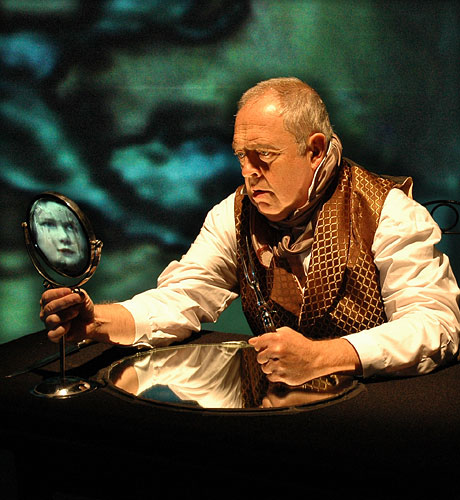
Review: Keith Hennessy's 'Saliva'

Only a hand-scrawled sign with the word 'Saliva' on an orange-and-white-striped construction barrier on Clementina Street hinted that there might be any kind of event going on Sunday night under the freeway.

But despite the chill, scores of people congregated under the graceful curving Fremont Street off-ramps, where performer and choreographer Keith Hennessy reprised his groundbreaking 1988 solo 'Saliva,' an inchoate mass of impulses, ideas, rage, humor and participatory episodes designed to elicit a response in the viscera.

San Francisco has a proud history of guerrilla art, and in the grand tradition, the police came by earlier in the day with a warning - lending a legitimizing whiff of the illegal to the proceedings. But with the air of a champion of public art in public places, Hennessy was characteristically unbowed.

Labels: , , ,

Thursday, December 10, 2009

'SenseScape': Chinese dance tradition updated

'SenseScape': Chinese dance tradition updated:

Traditional, classical Chinese dance gets a fresh flourish of energy in Lily Cai's newest creation, 'SenseScape.'

The Shanghai-born Cai is known for her blend of modern dance and Chinese influences, but whatever dance idiom she chooses, Cai's trademark is to give each work a unique texture. Cai - who founded her troupe in 1988 - credits the initial impetus of 'SenseScape' to composer Gang Situ, her longtime collaborative partner, who has created a partly original, partly sampled score for the work.

"It's about the human senses and the chi," Cai says, referencing the concept of energy and flow of life forces. "My technique itself is about the chi. In the past when I've choreographed, always I see an image first, but this time, I worked from the inside. I keep telling my dancers that the movement is just the result, like when you laugh or cry, you sense the sadness or happiness, then you start the action."

Main portion of the post


Rest of post here.

Labels: , ,

Monday, November 16, 2009

An interview with DV8 Physical Theatre's Lloyd Newson

Lloyd Newson talks about "To Be Straight with You" on KALW Radio

I haven't done radio for a while, but I got the chance to interview Lloyd Newson last week on KALW's New America Now program.

Labels: , , , , ,

Thursday, November 12, 2009

DV8's Newson discusses S.F. production

DV8's Newson discusses S.F. production: "Founded in 1986 by Australian-born Lloyd Newson - who studied psychology in Melbourne before joining New Zealand Ballet - DV8 Physical Theatre's unnerving and often raw work blends movement with text - sometimes provocative and unafraid to dive headlong into touchy topics like racism and religious intolerance."

Labels: , , , , ,

Wednesday, November 11, 2009

Dance review: Strong beats from 'L7,' Fauxnique

Dance review: Strong beats from 'L7,' Fauxnique: "What makes rhythmic repetition so compelling in some instances and yet monotonous in others? This past weekend it was possible to spend each day visiting vastly different dance performances - at the Cowell Theater, at CounterPulse, at ODC - delivering a veritable blur of styles: modern, hip-hop, kathak, folklorico, flamenco, voguing. What sticks in the brain, though, are those moments when mere beats somehow crescendoed into a tidal wave, when rhythm not only reflected an individual pulse but also took on the force of a gestalt grouping."

Labels: , , , , ,

Tuesday, November 3, 2009

Isadora Duncan Awards

Isadora Duncan Awards: "Dohee Lee and Jo Kreiter will be honored for outstanding achievement by the 24th annual Isadora Duncan Awards, which recognize contributions to Bay Area dance between Sept. 1, 2008, and Aug. 31, 2009.

Lee will be honored for 'Flux,' an interdisciplinary piece commissioned by the Yerba Buena Center for the Arts, and Kreiter for 'The Ballad of Polly Ann,' a tribute to the women who built the Bay Area's bridges.

The Izzies also will pay homage to dancer Marc Platt, known as Marc Platoff during his years with the Ballets Russes, for sustained achievement. The Ashkenaz Music and Dance Center in Berkeley and pianist Roy Bogas, whose sensitive playing has enlivened many a San Francisco Ballet performance, will be recognized for their contributions to the Bay Area dance scene."

Labels: , ,

Monday, November 2, 2009

Trey McIntyre Project's whimsical show pleases

Trey McIntyre Project's whimsical show pleases: "For a moment, as a pair of red balloons made a buoyant ascent into the air, it almost felt like the dancers of the Trey McIntyre Project - which made its first West Coast appearance as a full-fledged company at the Jewish Community Center of San Francisco's Kanbar Hall on Friday night - would float up next to them.

In many ways, McIntyre's 'Shape' - a helium-light, delightful interlude on a mixed program - epitomizes the kind of whimsical yet canny craft that has made McIntyre such a sought-after young choreographer."

Labels: , , , ,

Sunday, October 18, 2009

Dance Review: Trolley Dances a San Francisco Treat

Bright blue skies favored the sixth annual Trolley Dances, the itinerant series of performances in various sites along the J-Church line from Dolores to Balboa parks on Saturday and Sunday.

Most people on the first tour - there were half a dozen excursions each day - seemed to know all about the event, but a few were drawn up the hill to the statue of Miguel Hidalgo by the music of Mexican folklorico dancers Rosamaria Garcia and Jorge Rodolfo De Hoyos Jr.

Read more at the SF Chronicle website.


Labels: , , , ,

Sunday, September 27, 2009

Bill T. Jones finds inspiration in Lincoln

The historiography and legacy of the Abraham Lincoln phenomenon is at the heart of Bill T. Jones' latest work, "Fondly Do We Hope ... Fervently Do We Pray," which his company performs at the Yerba Buena Center for the Arts beginning Thursday. More than two years in the making, the work is a commission, by Illinois' Ravinia Festival for the 200th anniversary of Lincoln's birth, but it's also a project that has grown close to Jones' heart.

Q: You've talked about the struggle between the vision of Lincoln you had as a 5-year-old versus that of your older, more cynical self. How did that factor into "Fondly"?

A: Initially, I thought the approach was going to be prosecutorial, to challenge the theory of history. Let's challenge this great man, whom modern scholarship has revealed to be definitely just a man of his era and a politician to boot. I thought it was going to be about finding the person that I loved as a child, through what I now know about him as a man. And I found ultimately - after reading and working and thinking quite a bit - that he deserves my respect and, I would say in a more emotional way, he deserves my heart.

Read more on the SF Chronicle website.
Photo: Todd Heisler / NYT

Labels: , ,

Saturday, September 26, 2009

Dance Review: Margaret Jenkins Dance Company in "Other Suns"

At the heart of "Other Suns (A Trilogy)," the thoroughly engrossing work which the Margaret Jenkins Dance Company and China's Guangdong Modern Dance Company premiered at Yerba Buena Center's Novellus Theater on Thursday night, is the exploration of what it means to be "different" or the "same."

Far from being a mere cultural odyssey, or superficial pasting together of disparate items, Jenkins' work - set to a peripatetic original score by Paul Dresher, who led his musical ensemble in the pit - seeks something larger and more profound.


Part one - a section of the work that Jenkins showed to San Francisco audiences in 2007 - opens with designer Alexander V. Nichols' stunning visual space: Banks of lights across the upper and lower reaches of the stage frame dozens of bare lamps suspended like raindrops overhead, without the watery set piece seen in the 2007 showing.

Under the canopy of light, bodies thrust forward, push and pull against each other, evoking longing, daring, missed opportunities and chance encounters. Dancers off on their own suddenly and satisfyingly interlock in skillfully distributed groups. When Emily Hite launches herself off the feet of another dancer, her brief assisted flight is exhilarating.

Read more at the SF Chronicle site.

Labels: , , ,

Friday, September 18, 2009

Margaret Jenkins, Guangdong troupe pair up

Veteran choreographer Margaret Jenkins and her dancers join forces with China's Guangdong Modern Dance Company for "Other Suns," an intersection of cultures and ideas, which premieres Thursday at Yerba Buena Center for the Arts.

For Jenkins, it has been a process of more than two years that has taken her company of eight dancers to Guangzhou, China, in 2008 and back home as they worked on the tripartite work, which encompasses a section created by each company and a collaborative finale. As she prepared for the Chinese dancers' arrival in San Francisco, a moment in the quiet studios on Eighth and Folsom streets found her in a characteristically reflective mood.

Read more at the SF Chronicle site.

Labels: , ,

Reality star Payne dances her way to 'Fame'

Bubbly and unpretentious, Kherington Payne comes across as exactly the same fresh-faced girl who charmed fans of the reality show "So You Think You Can Dance" with her exhilarating Viennese waltz, spitfire krumping and, of course, the impassioned Mia Michaels number with Stephen "Twitch" Boss known as the "bed routine."

Growing up in Southern California, Payne took to competition, in the dance studio and on the sports field. A dancer since age 2, Payne got most of her early training at the Dance Precisions studio in Yorba Linda (Orange County), but she was also an avid soccer player in school.

"It's so weird to say that I loved both so much, because how you do both? But dance and soccer were just equally important to me," she says. "I would go to soccer practice and then run to dance in my soccer clothes and, sometimes, even dance in my soccer clothes. I loved both so much that I was willing to run from soccer games to dance competitions all weekend. I was just a girl without a social life."


Read more at the SF Chronicle site.

Labels: , , ,

Mark Morris Dance Group's ethereal 'Visitation'

In a world of dizzying and doubt-inducing complexity, there's something refreshing about the kind of direct and lovely simplicity that marks "Visitation," which the Mark Morris Dance Group performed to open the Cal Performances season at Zellerbach Hall on Thursday night.

Seemingly suspended in a state of expectancy, "Visitation" (set to Beethoven's sonata No. 4 for cello (Wolfram Koessel) and piano (Colin Fowler) is suffused with a kind of intimate anticipation. Groups break into pairs, dancers shift partners, intermingling duets for Joe Bowie, Noah Vinson, Michelle Yard and Rita Donahue pulse between sharp and soft, but throughout there's an ecstatic impulse in repeated arched backs and faces upturned toward the heavens as if hunting for salvation. And at the heart of the piece is a pensive Maile Okamura - a kind of outlier, though not an outsider to the group of nine dancers. Okamura invests the Beethoven score with a delicate yet passionate touch and it's infectiously delightful to watch her take to the air, hair flying across her face.

Read more at the SF Chronicle site.

Labels: , , ,

Sunday, September 6, 2009

Dance center celebrates 20 years in S.F.

Worlds collide at the corner of Seventh and Market streets. Across the United Nations Plaza is a weekly farmers' market. Up the street is the futuristic Federal Building. On the corner there's a check-cashing joint and a Chinese takeout place. Above it all, behind the ornate terra-cotta decorations on the 1909 Odd Fellows Building, is the Alonzo King Lines Dance Center, home to thousands of dancers and this year celebrating its 20th anniversary.

Founded in February 1989, the then San Francisco Dance Center - which moved into the upper floors of the Odd Fellows Grand Lodge in 2002 - quickly became one of the busiest locations for dancers and choreographers on the West Coast.

A walk down the slightly grim, fluorescent-lit corridor takes you past an extended frieze of dancers stretching as the echoes of piano accompaniment drift through the halls. But step into any studio and you're suddenly drenched in natural light that pours into abundantly airy spaces from the high, arched windows.

Read more at the SF Chronicle site.

Labels: , , , ,

Monday, July 20, 2009

Riding the Wave

WestWave Dance Festival
Cowell Theater, San Francisco
July 12, 2009

By the time we got to the Cowell Theater, full of anticipation for the 2009 WestWave Dance Festival, the line stretched far into the parking lot of the Fort Mason Center making the distance between us and the seats of the Cowell Theater feel like they were miles away. Patiently determined theatergoers, however, looked undaunted by the 20 minute wait (at five minutes to curtain) and box office mixups and by the time the show finally got underway half an hour late, the mood was unaccountably good-humored despite the obstacles.

(photo of Amy Seiwert by Andy Mogg)

In the long foggy San Francisco summers, WestWave Dance Festival's concentrated showing of local choreographers has long been an indispensable annual event for Bay Area dance aficionados. So it was happy news that despite tight financial times, producer Joan Lazarus was forging ahead with the festival this year, albeit in a shortened version -- one night only and with a limited number of companies participating.

Some of the work has been seen before, but worth a second--or third-- viewing. Katie Faulkner's seductive film "Loom" which traces the threads of a relationship played out between Faulkner and Private Freeman made an appropriately moody lead-in to "Until We Know for Sure," which the same two dancers performed live to snippets of music drawn from Maria Silva and Alfredo Duarte, among others. Floating in patches of light, Faulkner and Freeman melded one movement into the next with an ease and fluidity that still managed to surprise the eye with its impulsiveness. It doesn't hurt that the both of them have technical strength to burn--Faulkner's stability in a deep plie on half-pointe was mesmerizing, and Freeman's steady and attentive partnering was the linchpin on which the entire encounter turned.

Linchpins also leapt to mind while watching Amy Seiwert's latest "Response to Change" in which the choreography turns on split-second catches and fiendishly speedy interlocking of limbs. Dressed in purple tunics and t-shirts, Im'ij-re's four couples (Robin Cornwell, Vanessa Thiessen, Sharon Wehner, Kathi Martuza, Kevin Delany, Koichi Kubo, Matthew Linzer and John Speed Orr) work with seemed --given the score by Mason Bates entitled "The Life of Birds"--a fitful birdlike theme, although the demands of secure pointework seemed to make some of the women slightly cautious at first, though their confidence seemed to blossom as the piece developed, and one could only appreciate Thiessen's bullet-like pluck-- a pleasant counterpoint to Martuza's matter-of-factly, almost slyly, delivered supple extensions.

Also on the program was the premiere of Manuelito Biag's "Terra Incognita," a fractal of a dance that moved through solos, duets and trios for Biag, Kara Davis and Alex Ketley accompanied by song fragments composed and sung by Faulkner on guitar. On first view, "Terra Incognita" looks disjointed, dancers sussing out admittedly beautiful phrases of movement in a set dominated by bare lights and chairs. Davis and Ketley play out a tender pas de deux, Biag dances a solo with weighty moves that recall tai-chi, Davis flies about the space in an impassioned solo like a wild woman-- but still, this looks a bit like a dance being workshopped and still in progress. Nevertheless, as phrases of movement and music repeat and reassemble in ever-growing patterns a certain kind of organic order emerges. Even if the whole never seems to really cohere into a complete statement, it was worthwhile, both for the concept and the execution.

"Terra incognita" could well have described "*FLASH REAL* a Song Dance Cycle" Kim Epifano's mystifying and oddly frustrating journey through two years' worth of work which opened the evening. Accompanied live by composer and didgeridoo player Stephen Kent -- who also created the sound bed for this first of a multi-part work-- Epifano sang, swooshed and flew about the stage, drawing props and clothing Mary Poppins-like out of a capacious suitcase and seemingly menaced by a dangling crystal chandelier that loomed over the whole procedure like the sword of Damocles. I'm a bit of a skeptic at heart and any piece with a lot of running in circles tends to make my eyes narrow, but "*FLASH REAL*" was simply perplexing. Even though I had some awareness of Epifano's journeys to China, Tibet and Ethiopia, and followed her recent work, I couldn't fathom at all where she was taking us, although the collaboration with Kent looks like an avenue worth exploring.

Whether "Wake", the title of LEVYdance's offering on the WestWave program, refers to awakening, or to a funeral is unclear, although this lengthy duet for Brooke Gessay and Scott Marlowe felt as though it tended far more toward the sepulchral. As esoteric as I found "Wake," though, it's maybe a little unfair to try to re-evaluate this 2008 work based on this performance. Solemnly slow motion hip swivels and shoulder rolls were jarred out of focus by an obviously distracted and bored toddler who ran about the aisles and was finally removed shrieking from the auditorium. While I couldn't condone the impulse that led her parents to take her to what was obviously an adult event that was just too long for her, I also couldn't help but sympathize with her.

The evening closed on a similarly dark note with Patrick Makuakane's "From the last to the first," performed by the hula troupe Na Lei Hulu i Ka Wekiu. Beginning with a wailing lamentation and moving through somber ground through traditional dances to broadly curvacious choreography set to Roberta Flack's "The First Time Ever I Saw Your Face," this was hula seen in a serious mold. Unfortunately, although the power of the group and the sway of the mass of dancers onstage, in another context, might have been alluring and provocative, I was hoping not to leave the theater so depressed.

Labels: , , , , ,

Tuesday, April 21, 2009

Dance Review: Lerman's solemn, moving 'Dances' grips audience

'Try that word out loud - genocide,' says dancer Benjamin Wegman during Sunday night's performance of Liz Lerman Dance Exchange's 'Small Dances About Big Ideas' at the Jewish Community Center in San Francisco. 'It's a lot for one person to take in,' he concedes.

Tackling difficult issues - mass killings, bodies exhumed and identified, rape, torture - Lerman and her 11 dancers trace stories from the Holocaust to the mass killings in Bosnia and Rwanda. They're told often through specific histories, not only of victims, but also of those who sought justice, a "bone woman" who traces the graves of victims of the Rwandan genocide, the Polish activist Raphael Lemkin, who first used the term "genocide" and three Fates, led by the regal Martha Wittman, who interweave among the victims and the judges.

Read more at SF Chronicle.com.

Labels: , ,

Sunday, March 15, 2009

Dance review: ODC's 'Grassland,' 'Forest'

Questing and discovery loosely tied together two very different premieres at the ODC/Dance Downtown 2009 season, which opened with a gala performance Thursday evening, and which continues at the Novellus Theater in Yerba Buena Center through March 29.

At the heart of KT Nelson's "Grassland" - a new work set to a commissioned score by Marcelo Zarvos, and accompanied by Zarvos on piano along with a live string quartet under the direction of René Mandel - is a herd of wild things, pulsing with life.

Read more at the SF Chronicle site.

Labels: , , ,

Saturday, March 7, 2009

Dance review: David Rousseve's 'Saudade'

There are many words whose finer nuances escape exact translation into English, and yet there remains the sense that you can grasp the essence through the lens of experience, stories or analogies. Saudade is translated from the Portuguese variously as nostalgia or bittersweet longing, and David Rouss�ve's thoughtfully constructed dance-theater work 'Saudade' - a co-commission from the Yerba Buena Center for the Arts that opened at the Novellus Theater on Thursday night - attempts to get to the heart of the word with tales that reflect intermingling sadness and joy.

Read more at the SF Chronicle website.

Labels: , ,

Sunday, March 1, 2009

Ailey's humanistic vision touches the world

Although Alvin Ailey died in 1989, people who work at Alvin Ailey American Dance Theater tend to speak about the company's founder in the present tense: 'The most important thing to Mr. Ailey is that we be grounded human beings'; 'Alvin has always been a man of big dreams.'

That he remains a living presence to the people of the Alvin Ailey company is not only striking, but it also seems to be the singular reason for the extraordinary growth and longevity of the organization that he founded, which celebrates its 50th anniversary with three Cal Performances programs this week at UC Berkeley.

Keep reading at the SF Chronicle website.

Labels: , , , , , ,

Monday, February 23, 2009

Gerald Myers, 85, Writer on Dance and Philosophy, Dies

Gerald E. Myers, a scholarly expert on the philosopher William James who expressed his missionary zeal for modern dance through the highly unusual position of philosopher in residence of the American Dance Festival, died Feb. 11 at his home in New London, Conn. He was 85.


More on the NYTimes.com.

Labels: ,

Sunday, February 1, 2009

Dance review: 'Uncovered: The Diary Project'

These days, identity and the question of how we forge that identity are a hot topic - and a complicated one at that. The fluidity of self-categorization is eloquently investigated in Sean Dorsey's 'Uncovered: The Diary Project,' an evening made up of two dance-theater pieces - 'Lost/Found' and the world-premiere 'Lou' - which opened at the Dance Mission Theater on Thursday and runs through Sunday.

Read more on the SF Chronicle website.


Labels: , ,

Monday, July 7, 2008

Dance Review: Scott Wells & Dancers in "Home Again"


Too often in dance the word "line" is used to describe a static pose, but Scott Wells & Dancers' deft style of contact improvisation reminds us that "lines" should be continuous threads of movement that roll, knot, ravel and occasionally seem to trail off into space - concepts of motion turned into a physical reality.

It's a particular pleasure to see the company back in the cavernous, cathedral-like Project Artaud, which beautifully frames the airborne flights of Wells' 16th season, presented by ODC Theater through Saturday at Artaud, a temporary home while the ODC venue undergoes renovation.

Beyond the drama of what look like dangerously high-flying antics, Wells' dancers have a talent for drawing audiences into the exhilaration of launching a body through the air, and sharing the satisfaction of timing so accurate, it makes clipping onto a trusty partner look easy. In his 2007 "Gym Mystics," Wells' gleeful sense of play pervades the piece from the moment Rajendra Serber launches himself at a free-standing wooden beam to the simultaneous tumbles and cartwheels of eight dancers criss-crossing the stage speckled with Allen Wilner's smoky lighting.

Labels: , , ,

Monday, June 9, 2008

Dance Review: Joe Goode Performance Group-Remember the Wonder...

Midway through the performance of Joe Goode's latest "Wonderboy" -- at the Yerba Buena Center for the Arts through June 15-- the dancers operating the titular puppet abandoned their charge and left him sitting alone in his window, awash in drifting filmy curtains. Such was the storytelling power of this fabulous creature, though, that I continued to stare at him for several minutes, ignoring the dancers downstage. Somehow I wanted to see what he'd do next-- I wanted to catch what his reactions to the unfolding dance would be--even though I was quite aware that as a puppet, he wouldn't...couldn't possibly move.

Goode's latest collaboration with the San Francisco-born, now New York-based puppeteer Basil Twist (they worked together on Paula Vogel's "Long Christmas Ride Home" for the Magic Theater) makes for memorable theater. If the execution is not entirely perfect, the wonderful boy at the center of the story is charismatic enough to carry the show, which plays on a double bill with an abbreviated version of Goode's 1996 "Maverick Strain."

As in "Christmas Ride," the style reflects a modern version of the Japanese bunraku puppet form, in which the operators of the puppet are not only visible to the audience, but play characters of their own. In a strange way, the parsing of Goode's choreography, with slightly self-conscious, inward-seeking movements, makes an excellent match with the range of motion available to the boy himself.

In fact, the dancers (Melecio Estrella, Mark Stuver, Jessica Swanson, Andrew Ward, Patricia West and Alexander Zendzian) have obviously lavished attention not only on their own solos and duets, but also on matching their movement to Wonderboy's choreographed phrases. Perhaps though, there is no one better suited to this danced bunraku style than movement professionals. Accustomed to working in partnership and projecting the lines beyond their own bodies, the human performers generously transfer "realness" to this latter-day Pinocchio.

But making "realness" is also Basil Twist's stock in trade. A master puppeteer, who can seemingly enable any object--puppet or not--tell its own story, Twist imbues his boy with endearing details, an enigmatic lift to the corner of his lips, a sparkle in his eye, that continually draw your attention back to him.

As Wonderboy observed and commented on the workings of the world from his spare metal window frame-- just as the audience was watching from outside our own proscenium/window-- I couldn't help marveling at the enormous empathy I felt for the little guy. When he left the stage, I was a little unnerved and disappointed, like a kid whose friend has moved away, and when he tentatively dips his foot into the flow of life, I sensed a rush of exhilaration at his jetes from place to place. If only we could have flown up the aisle with him at the end.

Visit joegoode.org for more information on the show.

Labels: , , , ,

Sunday, May 18, 2008

Global perspective at S.F. Arts Festival

Multiculturalism is the watchword at the San Francisco International Arts Festival, which runs Wednesday through June 8 at a dozen venues around the city and will feature artists from China, South Korea, Australia, Brazil, Mexico, Israel, Spain, Germany and Croatia, side by side with such mainstays of the local arts scene as Joe Goode, Axis Dance Company, John Santos and Earplay. But while the out-of-town visitors are an appealing part of the 5-year-old festival, the brainchild of director Andrew Wood, it also, perhaps even more important, serves as a proving ground for international collaborations and a way of encouraging Bay Area artists to seek out inspirations abroad and bring back fresh ideas to their home base.

Whether through an existing project, like Kim Epifano's collaboration with Shanghai artists on "Speaking Chinese," or an outgrowth of an existing relationship, such as Mark Jackson and Beth Wilmurt's work with Berlin choreographer Sommer Ulrickson on "Yes, Yes to Moscow," or even a reason to fulfill a commission, like Erling Wold's one-man opera for John Duykers, the festival gives performers a venue and springboard for exploring outside their comfort zones.

Read more on the SFChronicle site.

Labels: , , , , , , ,

Saturday, March 8, 2008

Yayoi Kambara, mother and dancer at ODC

From the exhilarated smile on Yayoi Kambara's face as she flies through the air at her partner, Jeremy Smith, or floats on his extended arms, you can almost feel the thrill she takes in sheer movement. Rehearsing KT Nelson's "Walk Before Talk" for ODC/Dance's forthcoming season at Yerba Buena Center for the Arts, Kambara holds nothing back. If there's a sense that she's embracing the instant, that every second she gets to dance is one to savor, perhaps it's because for this new mother every moment - onstage or off, at home or in the studio - is precious.

Regular watchers of ODC/Dance's Downtown seasons might remember Kambara from last year in Nelson's "Water Project," in which she danced what might be thought of as the Earth Mother role while 37 weeks pregnant. Her daughter, Hanae - whose name means "flowering branch" - was born two weeks later, on April 11. Nelson says it was a major editorial shift in the ballet to include a pregnant dancer, but with three mothers leading the ODC organization - Artistic Director Brenda Way has five children, Nelson has a son and the school's director, Kimi Okada, is also a parent - incorporating Kambara's real-life experience into the piece was only natural.

Read more on the SF Chronicle site.


Labels: , , , ,

Alvin Ailey chief Judith Jamison on retiring

She is the public face of one of the most popular and successful dance companies in the world - an articulate and warmly generous spirit who has led the Alvin Ailey American Dance Theater for just over 18 years, handpicked by Ailey as his successor.

Under her direction, not only has the Ailey company grown from a small troupe of dancers struggling to fulfill the vision of its founder to an internationally renowned 30-member company, but it has also built its own $56 million building in the heart of New York - which also houses a second company as well as Ailey's highly regarded school - and achieved financial security with a $22 million endowment.

But with Judith Jamison's announcement last month that she plans to retire as artistic director by 2011, the question for the company is who can possibly succeed her? Jamison, 64, answers that question and others as she takes a break during her company's residency in Berkeley this week.

Read more on the SF Chronicle site.

Labels: , , , , ,

Saturday, January 19, 2008

Spoon & Katie Faulkner's little seismic dance: Filaments & Derivatives

Filaments & Derivatives
Spoon & little seismic dance
at CounterPULSE
January 18-20, 2008

The diminutive but versatile CounterPULSE space was crammed to the rafters, literally, for a Saturday night show of Filaments & Derivatives, a collaborative evening put together by Kegan Marling and Jane Schnorrenberg's Spoon and Katie Faulkner's little seismic dance.

All the attention seems wholly warranted -- after all, Faulkner's 2006 season in the same space generated a rare excitement with her polished presentation and multi-faceted program. I remember after seeing her show, I had the most satisfying kind of question in my mind, what would she do next?

Marling opened the evening with his solo Memory, a mannered, mildly humorous assemblage of eccentricities and peculiarities. If there's a confused pause at the start -- is this piece really serious or not?-- it's quickly dispelled by the opening bars of Irene Cara's "What a Feeling." Marling plays it all straight though, from the jerky marionette moves to the unnerving, pigeon-like gaze at the audience, and it's lifted from garden-variety dance, of the sort I used to see at college, by Marling's athletic grace.

Faulkner makes another foray into film with Loom, a rather sweet chronicle of the romantic ups and downs of a couple, played by Faulkner herself and ODC/SF's Private Freeman. The concept of the film, which gives the sense of falling from one scene into the next through still photographs, will be familiar to anyone who pays attention to HP ads, but Faulkner edits effectively, skillfully weaving threads of humor and non-linear sequiturs throughout.

Spoon premiered The Derivatives immediately afterward, but unfortunately after the larger-than-life Loom, this new work had a rather pedestrian air. Marling and Schnorrenberg, joined by Ross Hollenkamp and Rebecca Johnson, seemed to lack the energy to match their chosen score-- a mix that ranged from Philip Glass to Osvaldo Golijov to Cibo Matto--which was a pity because, at times, the bolts and catches of the partnering held the promise of developing into something meaty.

Similarly, Faulkner's Imprint, a moody kaleidoscope of shifting patterns for Carl Bellinghausen, Rebecca Gilbert, Heather Glabe and Chelsea Taylor, had moments of clarity, but ultimately looked like a work still under development.

Far stronger was Faulkner's unusual The Dry Line, which closed the hourlong program. Across a video projection of a storm approaching a lonely, weathered barn a trio women--Stephanie Ballas, Janet Das, and Marlena Penney Oden--drift like Fates, or weird sisters manufacturing a dream world. Faulkner's movement here is clean and definite, with a bit of An Afternoon of a Faun in the isolinear movements and flattened hands that look like they are drawn from ancient Egyptian paintings. The only danger with this piece is that the women, all strong performers, nevertheless are somewhat swallowed up by the video, which occasionally distracts the eye away from the people losing in the process some of the subtleties of their intricate trio. And after all, when all is said and done, it's Faulkner's choreography that I want to remember.

Labels: , ,

Tuesday, October 9, 2007

Choreographers take a quantum leap into physics

At first, the dancers step gingerly around the taut golden strings that crisscross the floor of ODC's theater space in the Mission. There's a low bubbling thrum in the air from musician and composer Albert Mathias' panoply of electronic instruments that gives the sense of a percolating atmosphere as Cherise Richards, Suzanne Lappas and Shannon Stewart experimentally twang and gather up various strands, nimbly threading their way through the web of bright yellow twine.

When choreographer Kathleen Hermesdorf gives the signal for the rehearsal to begin, however, the three lift fistfuls of string into a three-dimensional cat's cradle and begin marking out the twisting, vibrating phrases of Hermesdorf's latest work, "Fate + Longing =," a work that Motionlab will perform this week at ODC.

Read more on the Chronicle site.


Labels: , ,

Wednesday, September 26, 2007

Mark Morris' "Mozart Dances" at Cal Performances

Sept 21, 2007
Zellerbach Hall, UC Berkeley

I worry when a choreographer makes a full-evening length dance that works--one that's not a story-ballet or a polemic, that can keep an audience focussed and not fidgeting in their seats as you begin section 11 of a 12-part work.

Aw, hell, I think to myself, now every yahoo is going to think that they're as skilled as Mark Morris -- that they can pull off a whole night's worth of abstract modern dance just like "Mozart Dances," which had its West Coast premiere at Zellerbach Hall at UC Berkeley recently. He makes little things like organic form and reformed structure look too easy.

Facetiousness aside, however, Morris impressively leads the audience on an engaging excursion through a beautiful three-act work set to Mozart's Piano Concerto No. 11 in F Major, his Sonata in D major for Two Pianos, and his Piano Concerto No 27 in B-flat Major.

To call it ambitious would be patronizing. Morris is too canny a dancemaker to attempt a large scale work without thinking through the nuts and bolts and "ambitious" implies a certain amount of failure in the very word. "Mozart Dances" is not my favorite of his works-- I reserve that title for his exhilarating "L'Allegro"-- but it is both satisfying and successful on a grand scale.

The tone here is simple rituals, with shades of 18th century airs and graces, reflected in Martin Pakledinaz's black and blue-gray knee breeches for the men and diaphanous dresses for the women. Broken into a section mainly for women ("Eleven"), one mainly for men ("Double") and one for a happy intermingling of both genders ("Twenty-seven"), Mozart Dances seems to allude to everything and nothing. A wry comedy of manners? Sistahs doing it for themselves? Menacing, dangerous liaisons?

Morris famously admires the work of George Balanchine, and there's several "Serenade"-like moments of scattered throughout the evening -- the dramatic, plunging swoon to the floor, the gauzy moonlight skirts of the women during their brief interlude in "Double," the second act of the evening.

And yet it wasn't Balanchine that "Mozart Dances" evoked for me, but rather the earlier grittier "Les Noces," by Bronislava Nijinska, circa 1923. It wasn't the score -- Mozart is rather different from the pounding, earthiness of Stravinsky's peasant wedding -- but rather the look of things.

The stark force of Howard Hodgkin's curtailed, painterly brush-strokes-- writ-gargantuan on the cyc in the back-- the architectural groupings and waving of the women in "Eleven" recalled the severe austerity of Nijinska to my eye. Almost certainly, Morris had no intention of evoking a Nijinska's broadly-drawn modernist ballet, but all the same, my mind, grasping for narrative threads, settled on this one.

That there is a ritual feeling throughout "Mozart Dances" is no surprise, given Morris' mastery of the folk dance forms. The weaving patterns of the women as they wound in and out of Lauren Grant's dance in "Eleven" called up the braiding of the bride's hair in "Les Noces'" first tableau. Two poignant solos for other women brought to mind the lamenting mothers of the third tableau. And then the mixture of dreamy sentiment and manly urgency in "Double" made me think of the Consecration of the Groom scene. By the time the curtain rose on Hodgkin's final image -- this time featuring an angry red swath across the space, like virginal blood displayed on the wedding sheets -- I was sure I had the story nailed.

Am I way off-base with my Russian Peasant Wedding theory? Almost assuredly. Reviewing the "Mozart Dances" in the New Yorker, Joan Acocella reports that Morris himself cites the madcap ending of Mozart's opera buffa "Cosi fan tutte." Fair enough. Mozart's pretty far from Russia.

It doesn't stop me from secretly clinging to my theory. After all, that's the flexible pleasure of abstraction. Choose your story and run with it.

For more information, check out cal Performances'
extensive webpage on the event with links to video clips and program notes.

Labels: , , , ,

Tuesday, September 4, 2007

Bausch's 'Ten Chi' will haunt your dreams

There are those kinds of artists that impress, those whose work sticks in your brain and those who can change the way you think -- and then there are those that haunt your dreams. It is into the last category that Pina Bausch's Tanztheater Wuppertal falls.

I first saw her startling "Carnations" as a teenager, and I have never forgotten its bizarre, frightening and yet somehow moving imagery -- or how closely hilarity and sadness seemed to cavort together on a carpet of thousands of pink carnations. Was it absurd that she asked the audience to pretend-hug ourselves? But in the end, almost as if by magic, Bausch uncovered a deeper meaning to all of these gestures that left me feeling slightly forlorn. Perhaps underneath it all, I felt, even then, that Bausch was a romantic, and it seems over the years that her work has grown only more poetic.

With "Ten Chi," which Cal Performances presents this November at Zellerbach Hall, Bausch transports us to Japan, where she created and premiered this work in 2004 at the Saitama Arts Theater. Translated roughly as "heaven and earth," "Ten Chi" draws its inspiration from Bausch's and her dancers' experience of the Japanese culture as outsiders, the martial arts, the language, the everyday interactions.

It's a mix reflected in the wide range of musical sources, Asian and European, such as Ryoko Moriyama, Hwang Byungki, Kodo, Yas-Kaz, Gustavo Santaolalla and Rene Aubry, as well as experimentalists such as Portishead's Beth Gibbons, Plastikman (Richie Hawti) and Tudosok -- all played out in an exotically simple setting, shadowed by the tail of a giant whale sounding into the stage.

But if "Ten Chi" sounds potentially obscure, even frustrating, fear not. In the realm of postmodern dance, Bausch is the master of dance theater -- and artists from Bill T. Jones to Robert Wilson to William Forsythe owe her a debt. Dominated by powerful and extraordinary images, her works are at once grandiose and intimate, ridiculous and yet familiar, but always they have the power to reveal something you never realized about yourself. She might even ask the audience to do things that seem silly or uncomfortable, but by whatever means are at her disposal, Bausch intends to make us feel the desire to communicate, to reach out and touch someone.

I expect that my dreams will be haunted again, perhaps by leviathans in the ocean and scattered cherry blossom petals floating on the water, or maybe by the simplest of human gestures. You just never know what we might discover.

Highly Recommended

  • 'Mozart Dances' -- The Mark Morris Dance Group returns to Cal Performances with this evening-length work, whose rhapsodic flair has engendered comparison to Morris' grandest works, such as "L'Allegro il Moderato ed Il Penseroso." Details: Sept. 20-23, Cal Performances, Zellerbach Hall, UC Berkeley, $32-$72, 510-642-9988, http://www.calperfs.berkeley.edu.

  • Joffrey Ballet -- The quintessential American maverick ballet company performs homegrown works, including Twyla Tharp's "Deuce Coupe"; Laura Dean's segment from "Billboards"; and "Pas des Deeses," created by the great Robert Joffrey himself. Details: Oct. 4-6, Cal Performances, Zellerbach Hall, UC Berkeley, $34-$90, 510-642-9988, http://www.calperfs.berkeley.edu.

  • Armitage Gone! Dance -- Once known for confrontational punk-ballet, Karole Armitage introduces her new company to the Bay Area with the grand lyricism of "Ligeti Essays" and "Times is the echo of an axe within a wood." Details: Oct. 13-14, San Francisco Performances, Yerba Buena Center for the Arts, $27-$39, 415-978-ARTS, http://www.performances.org.

  • Oakland Ballet -- The beloved Oakland Ballet gets a new lease on life with a program of old favorites, including Nijinsky's "Afternoon of a Faun"; Marc Wilde's "Bolero"; and Ronn Guidi's "Trois Gymnopedies" and "Carnaval d'Aix." Details: Oct. 20, Paramount Theatre, 2025 Broadway, Oakland, $15-$50, 925-685-8497, http://www.rgfpa.org.

  • Lines Contemporary Ballet -- Celebrating its 25th anniversary, Alonzo King's troupe is joined by Zakir Hussain and the Philharmonia Chamber Players in a special program featuring two world premiere works. Details: Nov. 2-11, Yerba Buena Center for the Arts, Third and Mission streets, S.F. $25-$65, 415-978-ARTS, http://www.linesballet.org.

    'TEN CHI'

  • WHEN: Nov. 16-18


  • WHERE: Cal Performances, Zellerbach Hall, UC Berkeley


  • HOW MUCH: $34-$76


  • CONTACT: 510-642-9988, http://www.calperfs.berkeley.edu

  • Labels: , , ,

    Tuesday, July 31, 2007

    West Wave Dance Festival's Uni-Form: Ballet Program

    Dance fans can celebrate that like a cooling rainshower, the two week-long WestWave Dance Festival -- which runs through this weekend at the Project Artaud Theater in San Francisco -- has arrived to quench the summer dance drought.

    The festival, now in its 16th year, has found a fresh new focus this year, with carefully plotted programs that emphasize quality over quantity. The first week’s “4 x 4 series” offered a quartet of evenings, each centered on the work of a particularly notable, up-and-coming choreographer (Kate Weare, Christopher Morgan, Monica Bill Barnes and Amy Seiwert). And this week’s shows—categorized into evenings of ballet, world dance, modern and dance theater—feature programs entirely of world premieres, surely a surfeit of riches for audiences who crave to see new work.

    Perhaps it’s no surprise then that this year’s festival has been enjoying sold out houses, for Seiwert’s justifiably anticipated program, as well as for the “Uni-Form: Ballet” program on Thursday. True, all is not perfect. Given the contemporary styles on view in the latter program, it felt as if “ballet” was less a descriptor and more a convenient box to place works by people who have been ballet-trained and common to almost all was moody atmospheric music of the sort that could inspire a half a dozen new onomatopoeic categories: “oopy-bloopy” music, “cricky-cracky” music, “plinky-plonky” music. Still, if most of the works on Thursday night could have done with some judicious pruning, they were on the whole well-produced and offered satisfying moments that made viewing well worth the time.

    The program began with Irene Liu in Viktor Kabaniaev’s solo “Fragments of…” set to an oopy-bloopy score, created by Nicolas Van Krijdt. Dancing to sounds that evoked thoughts of undersea bubbles and phantom radio broadcasts traveling through space, Liu, who has apprenticed with Diablo Ballet, made the most of the choreography, creating effects that were both natural and disquieting with softly undulating arms and a twisting, snaking spine suspended in impossibly deep back arches.

    In what was perhaps the most entertaining and polished piece of the evening, Christian Burns played out a solo “Beneath Your Sheltering Hand,” against a wall-sized video of tropical and computerized interior scenes. Looking like a man in desperate need of a tropical vacation, Burns moved across the stage in frantic stammers and starts to Anthony Discenza’s sound score of garbled marketing tropes spoken through a voice synthesizer and hawking self improvement products that prey on our modern hypochondrias.

    Only one woman showed work on this program although female dancers outnumbered the male two to one —a sobering reminder that even today in the ballet world, there are plenty of women to dance, but very few who choreograph. Unfortunately, Martt Lawrence’s “Rogue,” an excursion for five women and two men was perhaps the weakest entry of the evening. Filled with much rushing about the stage, meaningful slashes at the air, and pregnant looks, it was a bit like watching a telenovela when you don’t speak Spanish. You’re aware that drama is definitely afoot, but you can’t understand a word of it.

    In “Digression,” composer Les Stuck -- who according to the program note, seems to think that he is the first musician ever to attempt choreography—offered an arrangement of dance phrases created by Alex Ketley. The six women ably took on the challenge of sometimes literally bone-crunching leaps and falls to the ground set against still moments of proferred limbs and ominous fingers circling overhead, all to Stuck’s own, rather cricky-cracky sounding score, although ultimately it looked less like a structured work, and more like an assemblage of steps.

    Live accompaniment from composer Jack Perla and cellist Sam Bass bolstered Mark Foehringer’s “In Fugue,” a faintly menacing and confrontational work for Katherine Wells, Maya Hey, Carlos Venturo, and Joseph Copley, as well as ODC’s Private Freeman, Brian Fisher and Diablo Ballet’s Jekyns Pelaez. Foehringer was fortunate to have such a heavy hitting list of performers, Wells, Freeman and Fisher in particular, who can express more with the spaces in between the movements than most dancers can with a panoply of technical feats.

    Still throughout Thursday’s program, one particularly vexing commonality stood out – the peculiar self-absorbed “windmills of your mind” style of dance marked by impressive, yet mechanical technical feats topped with a closed-off, sightless gaze into space --that has become so popular. Nowadays, watching contemporary dance can feel like an act of voyeurism, a discomfiting glimpse into the performer’s private madhouse. Is that really what makes a ‘serious” dance now?


    Labels: , , , , , , , , ,

    Sunday, July 1, 2007

    KQED Spark: Benjamin Levy

    With a body of work noted for its pulsing athleticism and intelligent composition, Benjamin Levy has become one of the Bay Area's most sought-after choreographers, creating a style marked by personal inspiration distilled into pure movement.

    Read the full profile on KQED.org

    Labels: , , ,

    Sunday, June 24, 2007

    Oakland Dance Festival 2007: Company C, ODC/SF & Jo Kreiter

    Summer festivals are a great time to see what dance makers have in the pot, and a worthy entrant into the flurry of such local events is the Oakland Dance Festival, organized and presented by Charles Anderson’s Company C Contemporary Ballet. Now in its fourth year, this two weekend event at the Malonga Casquelourd Center now has all the earmarks of a regular and welcome tradition.

    Joined this year by ODC/Dance as well as Flyaway Productions, Company C offered an evening-length program of six works that was a not-always-successful mixed bag. But then, what really makes festivals like this one important is that they offer a broader mix of companies – a tantalizing taste which can introduce each troupe to a varied audience of people who might not be familiar with their works.

    The action got underway with Charles Anderson’s new work, “Egyptian Two Step,” which, in a bit of a reversal, put the audience members, not in their seats, but standing on the stage itself.

    From off to the side, the stage manager intoned, “Dancers, places please,” and after a moment the curtain parted to reveal the fourteen members of Company C strategically scattered throughout the auditorium, on seats, in aisles. Chugging back and forth to the music of Arthur Jarvinen, they performed a jaunty little number that elicited a few chuckles from our side of the curtain.

    What Anderson referred to as his amuse-bouche however, elicited an ambivalent reaction. “Egyptian Two Step,” though mildly amusing, was constrained by how many steps could be performed on stairs or over the back of a seat. Then too, it didn’t exactly turn the audience-performer relationship on its head or break down barriers in the way that, say, the audience involvement pieces of the 1960s New York downtown theater scene used to. On completion, the audience dutifully flowed up the aisles into its more usual position and awaited the next piece, making one wonder what all of that was about.

    We were still grappling with that question when the curtain went up on Flyaway Productions in Jo Kreiter’s “The Grim Arithmetic of Water.” Kreiter’s work, which has included some interesting site-specific pieces, can exemplify the pleasant surprises of finding art and audience in a new locality, but in that regard, “Grim Arithmetic” is one of her more conventional “we’re on the stage, audience is in seats” sort of pieces.

    With only an excerpt of the full work offered without much in the way of context or notes, the subject of the 2004 “Grim Arithmetic” is more than a bit opaque and it seems unfair to overly criticize the content. Visually, Kreiter’s aerial maneuvers have the potential to create lasting images – an illusion of weightlessness that can seem time-stopping. In “Grim Arithmetic” however, the portentous rituals, the nearly nude woman splashing and slumping in a pool in the center, the pairs of dancers swinging from water-carrying yokes looked contrived and oddly limited as dance choreography. Best were the simplest moments, in which a dancer spun through space dangling from a suspended bucket of water, as if parched and struggling towards a life-giving force.

    Encompassing the middle portion of the evening were two pieces from ODC/Dance: “Scramble,” a recent premiere by KT Nelson, and Brenda Way’s witty 1994 “Scissor Paper Stone.” Perhaps because it’s a newer work, “Scramble” – a quartet for the powerful Anne Zivolich, Elizabeth Farotte, Daniel Santos and Justin Flores -- looks less polished than “Scissor Paper Stone,” which enjoys the double advantage of a winking, cinematic love triangle and Private Freeman’s wiseacre attitude. Nevertheless, that trademark ODC energy and flair punctuated both works.

    Company C closed out the program with Alexandre Proia’s romance for two couples, “Rhapsody in Blue,” and Anderson’s “Bolero,” set to the famous Ravel work and newly commissioned by the Mendocino Music Festival.

    The company now boasts a more solid core of dancers than ever before, although the stage at the Casquelourd Center seemed to rob the women especially of their usual attack. Pointe work looked particularly careful, rather than freewheeling or bluesy in the Gershwin “Rhapsody,” but then overall, Proia’s choreography is an awkward assemblage.

    The nine dancers of “Bolero” looked far more at ease, although smooth transitions in the partnering work still elude the men. Nevertheless, if this “Bolero” was less about the driving inevitability of fate and more a Spanish-spiced fiesta, it was brought into focus by the eye-catching Beth Kaczmarek, whose beautiful lines and carriage of her back lent credibility to her every step.

    This review first appeared in the Contra Costa Times.

    Labels: , , , , , ,

    Thursday, May 31, 2007

    Joe Goode's Humansville

    You have to hand it to Joe Goode. With “Humansville” --which the Joe Goode Performance Group premiered on Thursday night in the Yerba Buena Center for the Arts Forum in San Francisco— he breaks open the theatrical box with a highly effective dance theater installation with a style that few can pull off.

    Presented as part of the Deeply Personal Series at Yerba Buena Center for the Arts, the hour-long, site-specific work integrates live dance, music performance and video –both pre-recorded and live--with a dazzling complexity. From a purely technical standpoint, it is perhaps Goode’s most ambitious work, sectioning part of the open Forum theater into four living dioramas, some of which display Austin Forbord’s video projections against Erik Flatmo’s scenic elements. Jack Carpenter skillfully manages the tricky task of unifying the individual scenes with lighting, and the whole space is bound loosely by the ambient score by Joan Jeanrenaud-- a founding member of the Kronos Quartet-- who plays the cello from a mobile platform that can be wheeled throughout the performing area.

    Dispersed among the tableaux are the members of Goode’s current group of performers. Marit Brook-Kothlow and Felipe Barrueto-Cabello sit silently side-by-side opposite a gargantuan projection of a woman gesturing “come hithers” at us. Around the corner, Alexander Zendzian and Melecio Estrella, each in a separate tiled cell, fling themselves in synchronized desperation against the grey and blue walls. Dressed in powder pink 50’s crinolines, Jessica Swanson chats with her beau—another giant projection on the side of her wall-papered room, while in a red fuzz-lined alcove, Patricia West appears through a small window to gripe about a restaurant reservation while employing gestures that eerily mimic a weeping woman projected on a TV screen just below her.

    As with any installation art there are multiple layers and points of entry. You don’t have to start at any particular place, and you needn’t stay through the end of each of the 7-minute “plays.” In fact, there’s a passageway behind the walls where audience members are free to wander and peek through cut-out windows into the back of each scene, adding both interactivity to the work plus the disturbing sense that we are all peeping Toms, constantly trying to see what the neighbors are up to. Did the audience members who craned forward for a glimpse under the ruffled valance of Swanson’s window realize that their image was being projected larger-than-life on the other side of the wall?

    The combination of video with live action is highly persuasive. There is the sense of being immersed in a moment, but as with the installations of Bill Viola or Julia Scher, you also have a slightly creepy feeling that you’re being played. This is a risky and fascinating way to present questions about human nature, voyeurism, our understanding of others and of ourselves. How willing are we to cross over lines and put ourselves out there? When a projected woman holds out her hand and invites us to “touch me,” it takes several minutes for the crowd to figure out that someone has to walk forward and touch the projection before the sequence will continue, but once it becomes clear, the invitation evokes a kind of delight too, as if we’ve been wallflowers who are suddenly asked to dance.

    When the piece moves into a more conventional presentation style, however, the momentum wanes. After about half an hour of roaming and peeping, of intersecting with lives that are only partially observed and never fully understood, the lights in the Forum come up, signaling the shift to the second part of the show and the audience sits down obediently in bleachers facing the blank pair of angled walls.

    From here, the action moves into episodic dance segments that offer a prismatic view of some of the elements seen in the installations. The dancing is potent--particularly intense duets for Brook-Kothlow and Barrueto-Cabello. Nevertheless, we glean no further information about the personalities in the boxes and even with a final series of text snippets that address empathy and human connection, it’s not clear how to tie it all together. Plus it’s not nearly as much fun as walking in and around the action.

    Even so, “Humansville” is a compelling journey. The overall look is beautiful, melding together all the production elements masterfully and if Goode’s aim is to provoke, to invite us to think, then he succeeds at that-- admirably.

    This review first appeared in the Contra Costa Times.

    Labels: , , , ,

    Wednesday, May 23, 2007

    KQED Profile: Erika Chong Shuch

    "I want to take big questions of life that are the most intimidating and find a way to make them relatable."
    --Erika Chong Shuch

    Choreographer, director, dancer and teacher, Erika Chong Shuch crosses over boundaries in her works, which meld together theater, dance, science, poetry, music, video and mechanics to formulate multidisciplinary works of art-- in the truest sense of the term. Inspired by a wide range of subjects, from cannibalism to extraterrestrial intelligence, Chong Shuch nevertheless puts the focus on the drama of human experiences.

    SPARK follows Chong Shuch from the earliest stages of the creative process, as she embarks on One Window, a work that explores our relationship to boundaries and confinement and which was created as part of Intersection for the Arts' year-long Prison Project.

    A restless intellect, Chong Shuch dropped out of high school in San Jose at 17, yet still found her way into theater and dance at the University of California, Santa Cruz. After graduating, Chong Shuch danced in Seattle and in Berlin with Alex B Company and Sommer Ulrickson (Wee Dance Company) before returning to California to earn a master of fine arts degree at San Francisco's New College of California, where she also co-founded the multi-disciplinary Experimental Performance Institute.


    Read more on the KQED Spark website.

    Labels: , ,

    Monday, April 23, 2007

    KQED Profile: Janice Garrett

    Since its founding in 2001, the San Francisco-based Janice Garrett and Dancers has rapidly become one of the most respected small modern dance troupes in the Bay Area. Much of its success derives from the lively, athletic dances of Garrett herself, whose choreography is notable for as much for its craftsmanship as for its dazzling speed, musical clarity and wit.

    Garrett came to dance relatively late, at the age of 23, after she had already graduated with a B.S. in mathematics from Stanford. She subsequently studied dance at Mills College, and in 1980 moved to New York. It was there that she would join the modern dance company of Dan Wagoner, an alumnus of the Martha Graham, Merce Cunningham and Paul Taylor companies.

    After ten years in New York, Garrett returned to the Bay Area, although she continued to work extensively in Europe, choreographing pieces for the Scottish Dance Theatre, London Contemporary's 4D Performance Group, London Contemporary Dance School and at the School for Modern Dance in Denmark. At the London Contemporary Dance Theater, she collaborated with British director and choreographer Jonathan Lunn on a range of productions and built a reputation for whimsical, kinetic dances.

    Read more on the KQED Spark website.

    Labels: , , ,

    Thursday, April 19, 2007

    At City College, you can dance if you want to

    Affordable, little-known program celebrates its 70th anniversary

    "Do you want to dance with me?" a young man in a bright orange T-shirt asks as salsa music blasts through the air. "Or are you a tango?"

    Taken aback, I stammer that I'm just here to observe a few dance classes -- although ... the temptation to join the fun out on the floor lingers. Surely, no one would notice one extra student?

    Read on the Chronicle site.

    Labels: , , ,

    Monday, March 26, 2007

    Paul Taylor: Lines of Loss, Piece Period, Airs

    The world is an off-kilter, perhaps incomprehensibly violent place in Paul Taylor’s restive new work, “Lines of Loss,” which had its West Coast premiere when San Francisco Performances presented the Paul Taylor Dance Company at the Yerba Buena Center for the Arts in San Francisco on Tuesday night.

    “No one ever told me that grief felt so like fear,” author C.S. Lewis once wrote, and the observation rings truer than ever in “Lines of Loss,” where grief intermingles with danger, and the choreographer offers no easy answers as to why.

    Silhouetted against Santo Loquasto’s immense, darkly striated background, the eleven dancers process onto the stage as if entering a church. The mood is one of barely contained emotion, rumbling under the polite white unitards, and running like an undercurrent in the music -- by composers as various as Guillaume de Machaut, Christopher Tye, Jac Body, John Cage, Arvo Part and Alfred Snittke.

    Each section of the ballet takes its title from the last name of the composer, which leaves a certain implication hanging in the air. In “Tye,” Lisa Viola’s heartfelt contractions and pulls of the back suggested a soul yearning to break free, while Robert Kleinendorst’s twitchy solo in “Body” described a strange loss of self-control.

    But not just portraits of grief, Taylor also turns to scenes that grieve us. In “Cage” spiky pairs of men pound the floor rhythmically, and menace two women who have wandered into their clutches – Julie Tice and Michelle Fleet—and in a second section titled “Tye,” a seemingly idyllic community fractures into fisticuffs.

    It was an enigmatic ballet that at times seemed to make the audience uneasy – between sections there was often only rapt silence instead of the usual unnecessary applause. By the time a tempestuous Annmaria Mazzini unfurled a trembling and searing solo in the center of the circle of dancers, the sense of high emotion was palpable in the room.

    For the Paul Taylor Dance Company this season marks the last installment of a five-year running engagement at San Francisco Performances, and if you’ve been putting off seeing the company, now is the time to go, because the 53-year old troupe isn’t planning to return to SFP until 2009. A prolific choreographer, Taylor’s works range from the exhilarating abstractions to darkly ominous mediations to bright comic fluff, and this opening program, like the other two which the company performs through Sunday, had a taste of each.

    The evening’s comic relief came wrapped up in Taylor’s 1962 “Piece Period,” a relatively jolly, but also relatively forgettable bit of slapstick. You know you’re in for a bit of a romp when the curtain goes up on Richard Chen See in parti-colored tights and tunic with a jaunty beret on his head. “Piece Period” which the company hasn’t revived since 1979, sports an oddball menagerie of characters in some kind of absurdist village, dancing to another mix of Vivaldi, Telemann, Haydn, Scarlatti, Beethoven and Francesco Bonporti.

    Daffy without being too dimwitted, “Piece Period” flaunted some of Taylor’s most engaging dancers, Viola in a blue bustier flashing sly glints at the audience, Kleinendorst all bluster in candy red waistcoat and powdered wig, and a mincing triumvirate of women in pie crust collars bouncing hip bolsters under their skirts. The cartoons kept coming, and the dancers played them for all they were worth, with Amy Young notable for her ability to make silliness look classy.

    The evening closed with one of Taylor’s most satisfying ballets, the 1978 “Airs,” to the music of G.F. Handel. If Taylor’s choreography idiosyncrasies--those familiar circle dances, the peripatetic meanderings into and out of groups, the characteristic curved arms—look tired in other later works, here the patterns and steps hang together organically, with a sweeping logic that still allows the individual dancers to breathe freely. Parisa Khobdeh’s beguiling zest and Young’s gentle sways into spiral shapes stood out, as did Laura Halzack’s serene arms in the dreamy finale.


    Labels: , , ,

    Thursday, March 15, 2007

    San Francisco Ballet: Eden/Eden, Chi-Lin, Spring Rounds, Pacific, The Fifth Season,Carousel, Fancy Free

    The landscape is spare, but far from serene in “Eden/Eden,” Wayne McGregor’s ambitious and compelling ballet, which San Francisco Ballet gave its American premiere on Program 4 of their repertory season on Tuesday night. This is risky work for SFB, but ultimately both rewarding and haunting.

    Created originally for the Stuttgart Ballet, “Eden/Eden” is ostensibly about cloning, but, never simplistic, it’s also a meditation on the seductive intersection of technology and the human machine.

    “The process is as follows,” intones one of the five unseen vocalists in a scientific drone. Over the pulsing Steve Reich score from his opera “Three Tales”—conducted here by Gary Sheldon—their measured monologue sets us initially in the midst of the cloning debate.

    Muriel Maffre, in flesh-colored skivvies and skullcap, ascends into a stark spotlight, all androgynous, hairless muscle, while projections assembled by Ravi Deepres unfold like a universe behind her. Maffre has never had a problem with finding the beauty in an ugly line, and in “Eden/Eden” she makes the most of a torqued spine and limbs yanked in every direction. Joined in a weirdly agonistic duet by Gonzalo Garcia, they create a vision of biology gone haywire.

    Like Autons, the creepy mannequins of sci-fi’s “Dr. Who,” the dancers seem to multiply, eventually filling the stage with flails, as if the impulses for each movement were directed from the wrong nerve endings. Bathed in Charles Balfour’s sickly green-gray light, the figures in this fearsome gymnasium are nearly impossible to tell apart. And the whole exercise becomes even more disturbing when they shed their skullcaps and don Ursula Bombshell’s tunics to become individuals. There’s a moment of mental resistance--you don’t want to believe that these “Bladerunner” replicants could ever become human.

    McGregor--whose metier in his own company, Random Dance, is modern dance-- has his own lexicon of movement that is far from ballet-based, although curiously he utilizes the women’s pointe work effectively, perhaps because his understanding of the technique stems from expediency rather than tradition. Nevertheless, the dancers eat up this style and spit it out like nails, offering performances of surprising depth and aggression. If you find yourself seduced by the physical beauty and apparent perfection of the alien uber-humans before you--including Katita Waldo, Pascal Molat, Rory Hohenstein, Jaime Garcia Castilla, Moises Martin, and notably corps members Dana Genshaft and Hayley Farr-- you might notice that there are no apples on the silvery tree hovering in this Eden. That fruit has been plucked and we’ve all taken a big bite.

    Only a few weeks ago, when William Forsythe brought his company to Cal Performances, I wondered idly if San Francisco Ballet would ever perform a piece like his “Three Atmospheric Studies,” a complex, heavily text-based, but thrilling work with almost no traditional ballet steps. We have our answer. SFB Artistic Director Helgi Tomasson has taken an enormous risk in presenting McGregor’s very unpretty, but very absorbing work, and we can only hope that there more of these sort of challenges lie in the future.

    In a different vein, two other works premiered on the ballet’s Program 5 on Thursday night—none more anticipated than Christopher Wheeldon’s “Carousel (A Dance),” made originally for New York City Ballet. Set to excerpts from Richard Rodgers’ “Carousel” –the grand “Carousel” waltz and “If I Loved You”—this version offers a sketched, dream ballet of Julie’s ill-fated romance with smooth-talking carny Billy, danced on Thursday by Sarah van Patten and Pierre-François Vilanoba. In a lemon-colored dress with matching ribbon, Van Patten brings a lovely unsuspecting freshness to her role, although Vilanoba is perhaps a little too likeable to convince as her no-account beau.

    The main weakness in this “Carousel,” though, is the choreography. Wheeldon jam-packs every count with steps and the result, while impressive, hasn’t quite nailed the feeling of giddy freedom. Many of the lifts in Van Patten and Vilanoba’s duet were lovely, but with all the swooning and the swooping happening early in their waltz, there was very little room for emotional build.

    Wheeldon might do well to take a look at Jerome Robbins’ “Fancy Free,” which got more than a little lift from Molat, Anderson and Garcia as a trio of roguish sailors on shore leave. The young Robbins—who reportedly refined and pared back the more cartoonish antics of this larky 1944 vignette—offers more bang for your buck with a twitch of an eyebrow than all the swooning lifts in the world can accomplish. If the dancers (and the orchestra) could have been a little looser and jazzier to match the bounding Leonard Bernstein score, it was nonetheless a delightful excursion that brought an instant smile to the lips from the first burst of energy onstage.

    Filling out Program 4 were the Arcadian gambols of Paul Taylor’s “Spring Rounds,” led on Tuesday night by Vanessa Zahorian and Garrett Anderson, and Helgi Tomasson’s “Chi-Lin” with an inscrutable Yuan Yuan Tan in the title role. Program 5 saw the return of Mark Morris’ “Pacific” and Tomasson’s “The Fifth Season,” with the music delivered under the capable baton of Martin West.

    Labels: , , , , , , , ,

    Tuesday, March 6, 2007

    Alvin Ailey diva gets unexpected -- but wholly appropriate -- 25th anniversary gift

    You could say the Earth moved for Renee Robinson, the Alvin Ailey American Dance Theater diva who celebrated her 25th anniversary with the company in a special performance at UC Berkeley's Zellerbach Hall last week.

    Of course, it moved a little more than the dancers might have liked, but the New York-based company seems to take in stride little things like Thursday's 4.2 magnitude temblor, which struck during intermission.

    Read on the Chronicle site.

    Labels: , , , , ,

    Friday, November 24, 2006

    Dance Column: Holiday Treats

    A veritable bouquet of holiday treats are headed our way starting this weekend. Some are like old friends, back for their annual visit, and others are newcomers, but safe to say, we won’t lack for entertaining things to take the kids of any age to see throughout the month of December.

    ODC/Dance’s “The Velveteen Rabbit”

    Why do I love “The Velveteen Rabbit” so much? Is it because I’m a sucker for hard luck cases? Possibly. I get farklempt at the mere description of the threadbare, velveteen fur and shabby velvet nose.

    KT Nelson’s take on the tale of the “bunchy, fat bunny” and the boy who loves him has become an enduring holiday tradition, and justly so. This year marks the 20th anniversary of the enormously popular “The Velveteen Rabbit,” and a host of special guests will be on hand throughout ODC/Dance’s run to help celebrate. Among the events this weekend, Friday’s matinee (November 24) is Grandparent’s Day, Saturday (Nov 25) is ASL Signed Narration Day with actor Ty Giordano, and Sunday’s matinee (Nov 26) will be followed by a milk and cookies party with the dancers (Call the Yerba Buena box office for tickets to the party.)

    And as always, plan to bring your stuffed animal friends along to enjoy the show. Don’t they deserve a night out too?

    ODC/Dance performs Margery William’s beloved classic November 24 – December 10 at the Yerba Buena Center for the Arts in San Francisco. (www.ybca.org, 415-978-2787)


    Smuin Ballet “Christmas Ballet”
    Fans of Michael Smuin’s holiday revue are in for a treat this year as the Smuin Ballet adds seven new numbers to the lineup, including three by Michael Smuin, two contributions from associate director Celia Fushille-Burke, and one apiece from Amy Seiwert and Shannon Hurlburt. With newly refreshed sets and costumes, this Christmas buffet, which comes in hot and cool versions, puts a sassy spin on the Christmas roundelay.

    The 2006 edition of the “Christmas Ballet” makes its bow on the stage of the Dean Lesher Regional Center for the Arts November 24-25. Or you can catch it at the Yerba Buena Center for the Arts from December 15-24. (www.smuinballet.org, 925-943-SHOW or 415-978-2787)


    Moving Arts Dance Company’s “MAD Hatter” Performance and Tea Party
    For something a little more unusual, follow Alice’s granddaughter Allyson down the rabbit hole at Moving Arts Dance Company’s second annual “MAD Hatter” Performance and Tea Party. There are sweets aplenty on the table and on the stage as choreographers Anandha Ray, Michael Lowe, Dudley Brooks, Jenny McAllister, Dianna Rowley, and Isabelle Sjahsam offer up their version of life in Wonderland.

    Moving Arts will have two shows in San Francisco at the Cowell Theater on December 2 (www.fortmason.org, 415-345-7575) and two shows at the beautiful El Campinil Theatre in Antioch on December 9 (www.elcampaniltheatre.com, 925-757-9500).

    Diablo Ballet’s “Nutcracker”
    In collaboration with Civic Arts Education, Diablo Ballet will unveil its very first production of the “Nutcracker” at the Del Valle Theater in Walnut Creek. Directed by the Diablo Ballet Intermediate Program’s Rebecca Crowell, the production won’t lack for talent. Leading the cast of 58 dancers – which includes children and adult drawn from all over the East Bay, as well as the Diablo Ballet apprentices – will be Tina Kay Bohnstedt and Vikot Kabaniaev as the Sugar Plum Fairy and her Cavalier. Lauren Main de Lucia and Matthew Linzer will rule over the Land of Snow, and Nikolai Kabaniaev, Diablo’s co-artistic director, will even take his turn onstage as Herr Drosselmeyer.

    Diablo Ballet’s “Nutcracker” premieres at the Del Valle Theatre in Walnut Creek, December 1-3. (www.diabloballet.org, 925-943-SHOW)

    San Francisco Ballet “Nutcracker”
    The gold standard of "Nutcrackers” around here has always been the San Francisco Ballet production and Helgi Tomasson’s grand version, with its spectacular, larger-than-life sets and costumes holds delights for kids of any age. With dreamy scenes and even dreamier dancing, this “Nutcracker” is sure to send patrons, young and old, twirling out into the streets.

    At the regular family performances, there’s milk and cookies in the lobby, plus, SFB also offers a chance to give a little holiday delight with the annual San Francisco Firefighters Toy Drive. Bring along a new toy or book to donate when you come to the show and the SF Firefighters will see that it brightens a needy child’s Christmas.

    San Francisco Ballet’s “Nutcracker” runs December 14-31 at the War Memorial Opera House in San Francisco. (www.sfballet.org, 415-865-2000).

    Contra Costa Ballet "Story of the Nutcracker"
    For an early start on the holiday season, you can see the Contra Costa Ballet’s "Story of the Nutcracker," an hour-long version of the ballet, which features Diablo Ballet’s David Fonnegra and Company C’s Jenna Maul as the Sugar Plum Fairy and her Cavalier.

    The Contra Costa Ballet performs their version of the holiday classic from November 30-December 2 at the Dean Lesher Regional Center for the Arts in the Hofmann Theater. (www.contracostaballet.org, 925-943-SHOW).


    Berkeley Ballet “Nutcracker”
    Teacher, choreographer, director, Sally Streets has been a mainstay of the Bay Area ballet scene, and this year the company she founded, Berkeley Ballet Theater, celebrates its 25th anniversary. Streets and Robert Nichols choreographed this colorful and lovely version of the Tchaikovsky classic to make a more intimate experience.

    To kick off their anniversary season, they’ll be performing their production of the “Nutcracker” from December 8-17 at the Julia Morgan Theater in Berkeley. (www.berkeleyballet.org, 510-843-4689)


    Labels: , , , , , , ,

    Thursday, October 26, 2006

    Lyon Opera Ballet spotlights three women choreographers

    Lyon Opera Ballet
    “Die Grosse Fuge,” “Fantasie,” “Groosland”
    Cal Performances, Zellerbach Hall, UC Berkeley
    October 27-28,2006

    When the Lyon Opera Ballet -- which Cal Performances presented at UC Berkeley’s Zellerbach Hall last Friday and Saturday nights -- gets on stage, there’s one thing you can be sure of, there will be athletic inventions of mind-bending capriciousness in the offing.

    The works that this attractive troupe performs tend to be highly energetic and physically alert on the most obvious level, but what’s most appealing is the satisfying meatiness underneath. Their triple bill this time – featuring the works of Anna Teresa de Keersmaeker, Sasha Waltz and Maguy Marin – was not a program of esoteric intellectual works, but it was smart and even provocative on a number of levels.

    The Belgian De Keersmaeker’s “Die Grosse Fuge,” for instance, made a galvanizing vehicle for the company.

    On a bare stage under the hot exposed glare of a grid of lamps, seven men and one woman play out a high velocity contest in Ann Weckx’s dark business suits. Spiralling through the air with limbs flung wide or in contracted balls, they tumble and roll to the ground with an almost intoxicated zest to the music of Beethoven’s “Grosse Fuge,” as recorded by the Quatuor Debussy.

    Although there’s a story inherent in the simple fact of putting a single woman -- Caelyn Knight -- amidst the men, De Keersmaeker doesn’t make too much of the situation, rather illustrating the fugue form in the complex patterns of choreography as dancers pick up phrases of movement and then pass it to others in rolling canons. Knight devours space as hungrily as the men, rolls up her sleeves with them and takes her tumbles to the floor with the same aggressive confidence that marks all of the Lyon dancers. But doubtless De Keersmaeker’s objective is to make you notice the very fact that you’ve noticed that there is only one woman.

    Sasha Waltz’s hazy, dreamlike “Fantasie,” which followed on the program, covers different and even more ambiguous ground. Created for the Lyon Opera Ballet and premiered earlier this year “Fantasie” – danced first in silence, then to a recording of the Schubert Fantasie in F minor – effects some arresting scenes. At the start Bruno Cezario and Fernando Carrion Caballero confront each other in an unsettlingly slow encounter in which Caballero’s arm seem to pass through Cezario’s body. Yu Otagaki tightrope walks into Caballero’s orbit for a duet of garishly twisted limbs and other dancers join them, swaying in a knot in the corner.

    In Martin Hauk’s shadowy darkness, some of the imagery is compelling. Still, one can’t help feeling that the work lacks development and is over-long. For a lengthy section of the ballet, the dancers seem to take a childlike pleasure in flitting about the stage with “airplane arms” but the story seems lost until we see Otagaki melting away from Caballero. He appears stricken and all the dancers vanish leaving Cezario alone onstage, as if within a fading dream.

    And then you have to wonder Maguy Marin’s dreams look like. Her diverting 1989 ballet “Groosland” puts 20 dancers onstage, looking uncharacteristically zaftig in Montserrat Casanova’s padded “fat suits” featuring prim blue and chartreuse outfits. They mince and teeter through complicated little folk dances with a nimble charm that elicited not a few chuckles from the audience and the Rubenesque dancers are rather touching in their obvious delight in dancing to Bach’s Brandenburg Concertos. These characters are obviously far more comfortable with their illusory flesh than you or I might be with a real body, and when the dancers strip off the blue and chartreuse to romp “naked,” we’re reminded that this or any other body is just a vehicle, and that the real grace comes from the dancer within.

    This review originally appeared in the Contra Costa Times.

    Labels: , , , , ,

    Friday, October 20, 2006

    Theater Review : Theatre of Yugen: Noh Pressure Cooker

    First let me say that I'm all for the trying. The Noh Pressure Cooker Festival, which ran over three weekends in October, is meant to offer a range of new works by the NOHSpace's resident troupe Theatre of Yugen. Now in its 28th season, this active group of performers studies a variety of techniques centered around the venerable 600-year old Japanese theater form, but their focus in the Pressure Cooker Festival is new work and contemporary stories. Anyone wandering in looking for a classical Noh version of The Tale of Genji is in the wrong place.

    If the air of experimentation is admirable, however, the execution still leaves something of a slapdash feeling. Enthusiasm for their work obviously informed the three pieces on display on the second weekend, but the overall impression was that these were works-in-progress that, for the most part, were just not thoroughly thought out.


    Read more on KQED.org's Art & Culture site.

    Labels: , , , ,

    Saturday, October 14, 2006

    Dance Review: Gamelan Sekar Jaya's "Kali Yuga"

    Gamelan Sekar Jaya
    “Kali Yuga: The Age of Chaos”
    Cal Performances, Zellerbach Hall, UC Berkeley
    October 14, 2006


    A fantastical battle between gods crosses paths with the realism of a modern world out of balance in Gamelan Sekar Jaya’s spell-binding drama “Kali Yuga: The Age of Chaos,” which premiered in its entirety at Berkeley’s Zellerbach Hall on Saturday night.

    Co-sponsored by Cal Performances and World Arts West, this lavish, multi-textured work draws its inspiration from Hindu cosmology in which the last of the four cyclical yugas, or ages of humanity, is called the Kali Yuga, a dark time marked spiritual dissolution, conflict and hypocrisy. Gamelan Sekar Jaya performed excerpts of the evening-length piece at last year’s San Francisco Ethnic Dance Festival, and it is a such worthy theatrical spectacle that it seems a real pity that there was only one day of performances it.

    A collaboration that brings Hindu together with Muslim, American with Balinese, “Kali Yuga” could be taken as a microcosm of a land of diverse contradictions – a paradisical island steeped in Hindu mythologywhere families still give offerings to the gods to protect their rice paddies, and a part of a Muslim nation torn by religious conflict and terrorist violence. Directed by Ellen Sebastian Chang -- who also directed the 2001 “Kawit Legong”— this richly appointed production finds the kind of unique flavor of fusion that we’ve come to expect from this American gamelan ensemble.

    Founded in 1979, El Cerrito’s Gamelan Sekar Jaya – whose name means “victorious flower orchestra” in Balinese – has become one of the most distinguished groups of its kind in or outside of Bali. Under the musical direction of Indonesian guest artists I Made Arnawa and I Dewa Putu Berata, Sekar Jaya impressively navigates the music composed by Arnawa, along with the troupe’s general manager Wayne Vitale.

    The term “gamelan” refers to a set of metal or bamboo instruments, and each gamelan collection is tuned as a unit, with the instruments always remaining together, no matter who the players are. Sekar Jaya is comprised of five smaller gamelan ensembles whose potent combinations of percussion instruments include small metal pots, gongs, drums, flutes, and jegogan made from giant bamboo tubes, among many others. There is a universe implied in the gamelan sounds, which can elicit the sense of consonant order or dissonant chaos with equal ease, and it all adds up to a robust and deeply satisfying layering of sound that fill the ears literally, even as Elaine Buckholtz’s visuals and Jack Carpenter’s lighting fill the eye.

    The thirty musicians of Gamelan Sekar Jaya’s ensemble make for an impressive centerpiece, enfolded by a U-shaped ramp along which unfolds the epic battle between Dewi Sri, the Balinese Rice Goddess and Bursasana, a demon who disturbs the order of the universe. Looming overhead is a rough circular hanging woven out of palms highlighted by a palette of light and shifting projections, but the bulk of the action takes place at the front of stage, where divine battles metamorphose into seemingly innocuous jaunts by tourists traveling through Bali or a masked dance turns into a modern rave. It’s a pleasing arrangement which places the musicians in the middle, and sometimes as a part, of the dance drama.

    Part mythos and part morality play, “Kali Yuga” unfolds in seven episodes. There are ritualistically paced Balinese dances from the Rice Goddess – an elaborately costumed Tjokorda Isteri Putra Padmini -- and her four acolytes. I Ketut Rina unleashes savage gravelly screeches and raucous laughter as the demon Bursasana, who tempts “Kali Yuga” choreographer I Wayan Dibia, as the Man with Four Faces, while they dance an unsettling series of topeng or masked dances. There’s a nightclubbing rave, a kind of contemporary version of the Balinese warrior’s kecak dance. And as a modern tourist, Oakland rap artist Rashidi Oman-Byrd even throws in a few hiphop moves as he raps the words of Jakarta-based poet Goenawan Mohamed.

    Ambitious in scope, “Kali Yuga” gets at a multiplicity of concepts, but underlying it, there is the sense that in a world wracked by violence, nightclub bombings, vice and corruption, there is still the hope of order and consonance rising from the chaos.

    If the ending -- a few lines spoken by children -- seems inconclusive and vague, still “Kali Yuga’s” emotional resonance hangs in the air like the reverberant sounding of the gongs.

    This review originally appeared in the Contra Costa Times.


    Labels: , , , ,